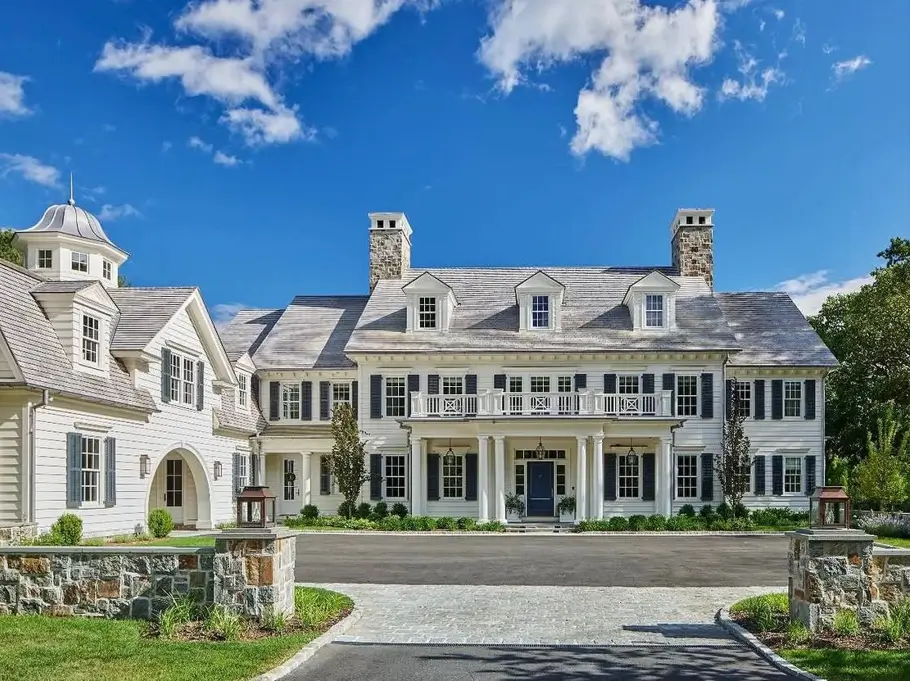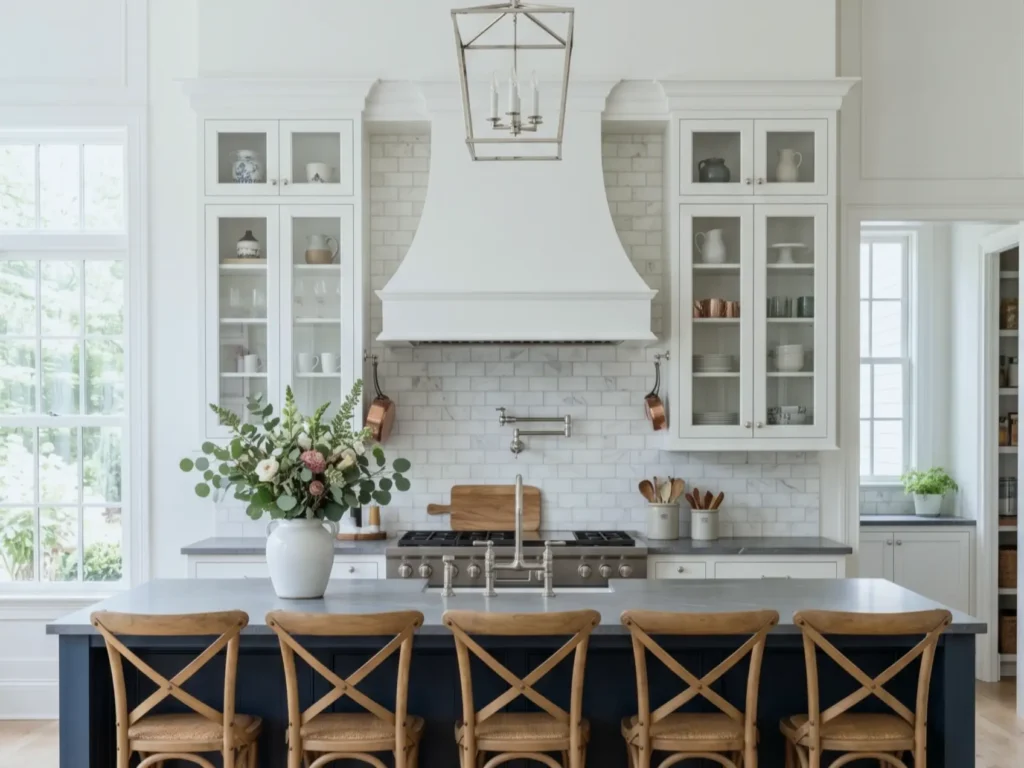

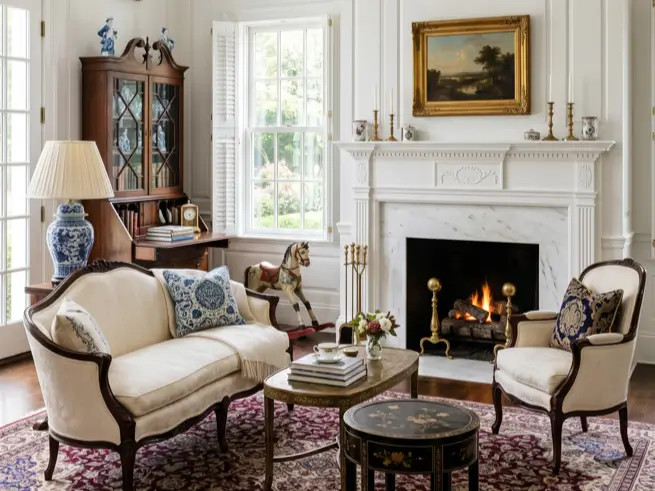
Colonial interior design style is a traditional, collected look built on dark wood, balanced proportion, and furniture that feels gathered over time rather than bought all at once. But here’s what trips most people up: there are actually two Colonials. One is American — formal, symmetrical, built around a fireplace and fine millwork. The other is British — relaxed and tropical, all dark teak against white walls, rattan, and plantation shutters.
I’m Naraphon, an interior designer based in Bangkok, and after years working inside both kinds of homes, I can tell you this mix-up comes up constantly. Someone tells me they want a Colonial interior design style home, then can’t quite name which version they’re picturing. Knowing the difference is what makes the whole look finally click into place.
Below I’ll walk you through both — how to tell them apart, the palettes and materials that define each, the architectural details that carry them, and a set of rooms I’ve pulled together to show the style in practice. If you’re shaping the outside too, my Colonial house design ideas guide is the companion piece to this one.
American vs. British Colonial: What’s the Difference?
American Colonial is the formal, symmetrical style of early Northeastern homes, while British Colonial is the relaxed, tropical look the British carried to warm climates. Both share dark wood and a collected feel, but they read very differently in a room — American is grounded and ordered, British is breezy and traveled.
Here’s how I explain the two side by side:
| American Colonial | British Colonial | |
|---|---|---|
| Origin | Early settler homes in the Northeast | British homes in tropical colonies |
| Mood | Formal, balanced, grounded | Relaxed, traveled, collected |
| Palette | Creams, muted blues, sage, navy, brick red | White and pale walls, blue and green accents |
| Wood | Mahogany, oak, pine | Dark teak and mahogany |
| Signature furniture | Glass-front cabinets, pedestal tables, four-posters | Rattan, cane, bamboo, campaign chests |
| Windows | Tall multi-pane double-hung, simple curtains | Plantation shutters, louvered doors |
| Walls & detail | Raised-panel wainscoting, crown molding | Botanical prints, grasscloth, greenery |
| Anchored by | A central staircase or fireplace | Dark wood against white, with plants |
The fastest way I tell them apart in person: if the room feels built around symmetry and a fireplace, it’s American. If it feels built around warm wood, white walls, and greenery, it’s British. In the homes I work in, most lean clearly one way — and the moment a client can name which, the rest of our decisions fall into place.
Key Features of Colonial Interior Design Style
Colonial interior design style is defined by a handful of consistent features — symmetry, natural wood, fine millwork, and collected, antique-leaning furnishings — many rooted in the Colonial Revival style that shaped so many American homes. These turn up in both the American and British versions, which is what makes a room read “Colonial” at a glance.
The features I look for first:
- Symmetry and balance — matched pairs, centered fireplaces, even window spacing.
- Dark natural wood — mahogany, teak, oak, and pine in furniture and floors.
- Fine millwork — raised-panel wainscoting, crown molding, and paneled doors.
- Multi-pane windows — tall double-hung sashes, often with shutters.
- A calm, muted palette — soft neutrals lifted by blue, green, or brass.
- Collected antiques — blue-and-white porcelain, landscape oils, brass, leather, and worn rugs.
A few things I tell clients from my own projects:
- Where to start: buy one good wood anchor first — an antique chest, a glass-front cabinet, or a sturdy dining table — and build the room outward from it.
- What to avoid: matching “furniture set” looks and glossy, brand-new finishes. A Colonial room should look gathered over time, not bought in a single trip.
- Smart substitutes: I’ll happily use a well-made reproduction in place of a costly antique; faux-bamboo or cane captures the British Colonial look for less; and a soft, historic paint color does a lot of the work when a full-millwork budget isn’t there.
Where the Colonial Look Came From
Colonial style began when settlers blended the traditions of their home countries with the materials and climate of a new place.
In early America that meant English proportion in local pine — the same plain, sturdy spirit you still see in traditional country house designs; in the tropics, British families had local artisans build in teak and mahogany; and in former Spanish colonies, carved cane chairs sat on cool marble floors.
That meeting of the familiar and the local is the whole heart of it, and the part I find myself most drawn to.
1. Early Colonial Dining Room
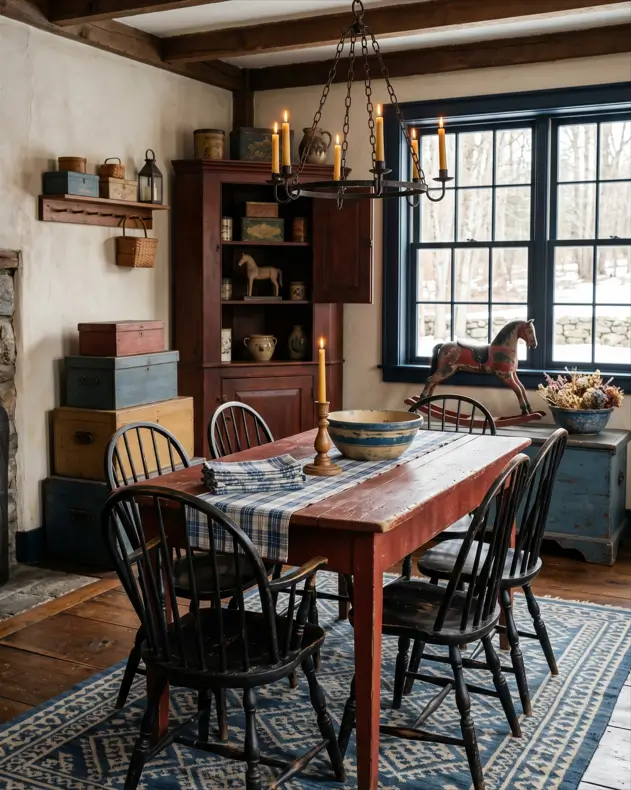
Hand-hewn beams and Windsor chairs take the look right back to early American homes, and I find rooms like this the most honest of the lot. A red-painted farmhouse table, a corner cupboard of redware, and stacked antique boxes feel truly of the period, lit by a simple wrought-iron candle ring. Nothing here is fussy, and that’s exactly why I love it.
2. Heritage Colonial Parlor
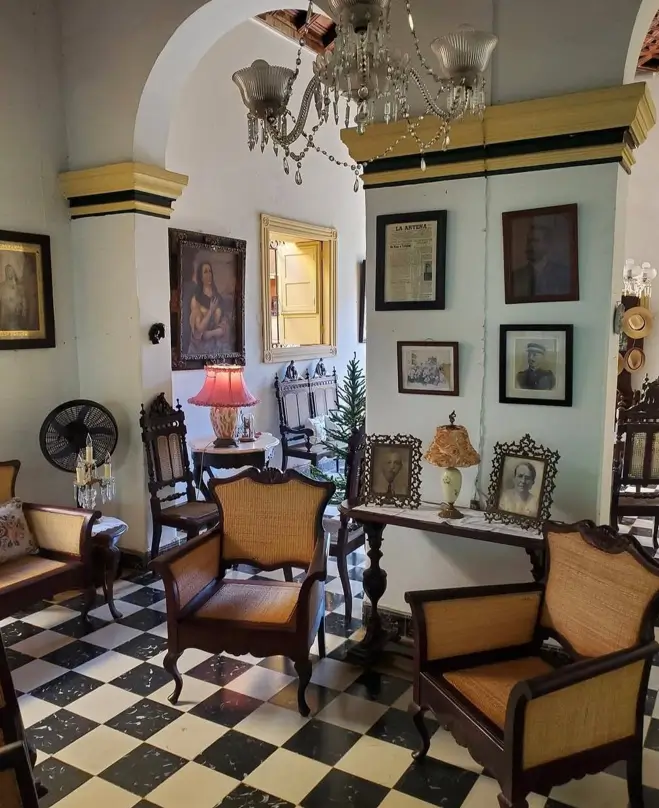
Whenever I want to show clients where colonial style began, I point to rooms like this one in the grand old homes of former colonies. Carved mahogany cane chairs and checkerboard marble floors set the tone, while religious paintings, ancestral portraits, and crystal chandeliers carry generations of history. To me it feels wonderfully authentic.
American Colonial Interiors: Formal, Symmetrical, Grounded
American Colonial interior style — the same New England sensibility you’ll find in Cape Cod style homes — is defined by symmetry, fine millwork, and a calm, grounded formality. Think central staircases with turned balusters, raised-panel wainscoting, crown molding, and a fireplace holding the center of the room.
The palette stays soft, and dark wood adds the weight. I see it work best in living rooms, dining rooms, and entries, where balance matters most. One thing I always notice in these homes is how a single antique chest or a stack of blue-and-white porcelain can anchor an entire room — the same trick that grounds Craftsman home interiors.
3. Sage-Paneled Entryway
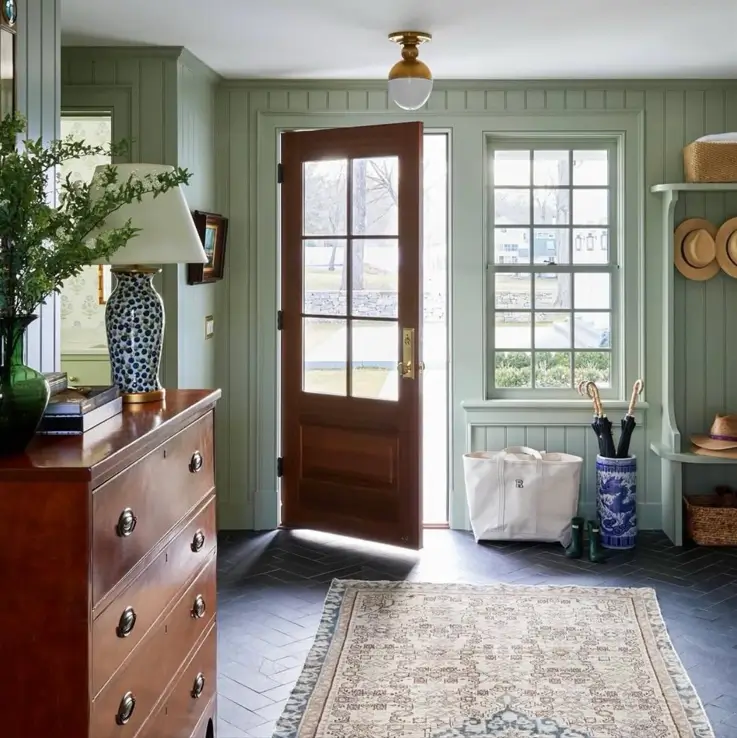
Soft green paneling sets a calm, grounded tone the moment you step inside, and it’s one of my favourite ways to open a home. I’d anchor the entry just like this — an antique mahogany chest, a blue-and-white porcelain lamp, a worn rug over herringbone. It feels collected, never staged.
4. Built-In Mudroom Bench
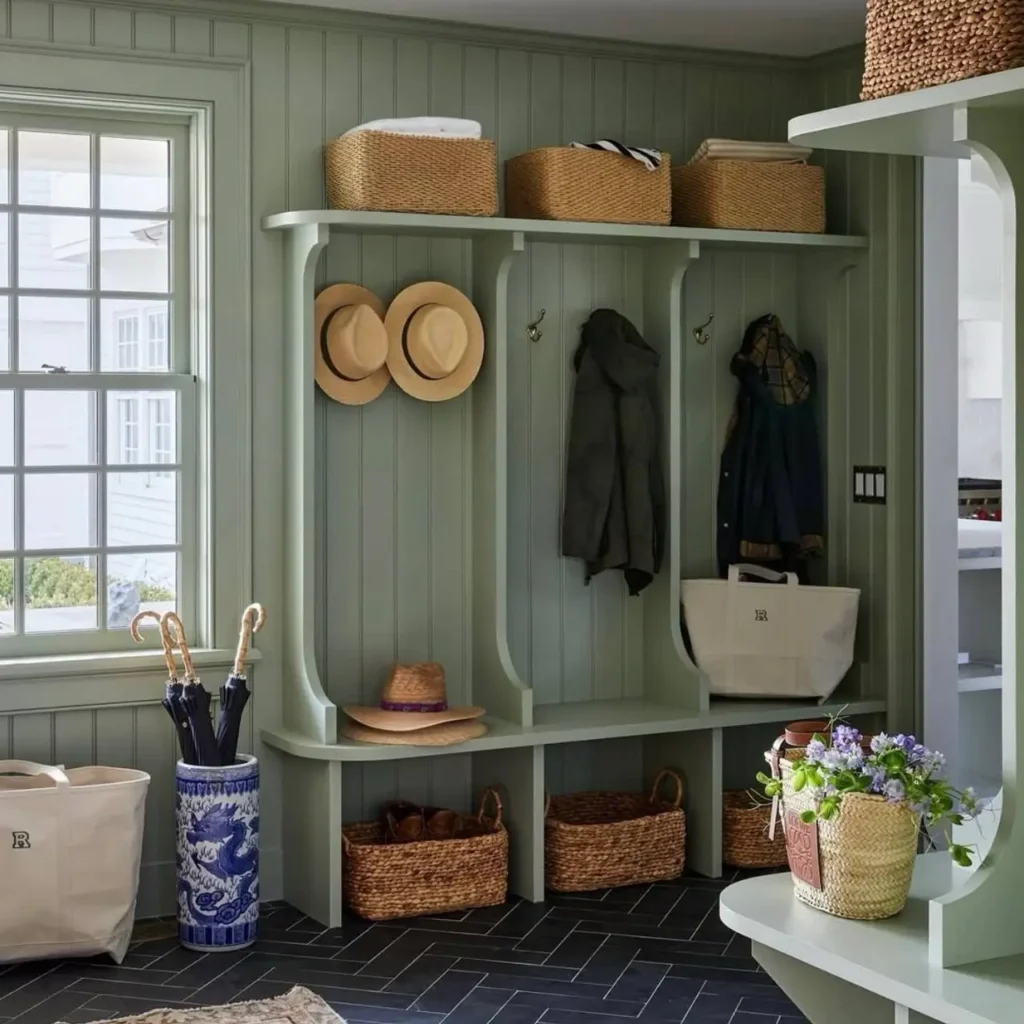
Beadboard built-ins turn a working entry into something quietly elegant, and I specify them often. In this sage-green mudroom, open hooks and a row of woven baskets keep coats, hats, and boots in order without a single cabinet door. Practical things, handled with the kind of charm I always aim for.
5. Central Staircase Hall
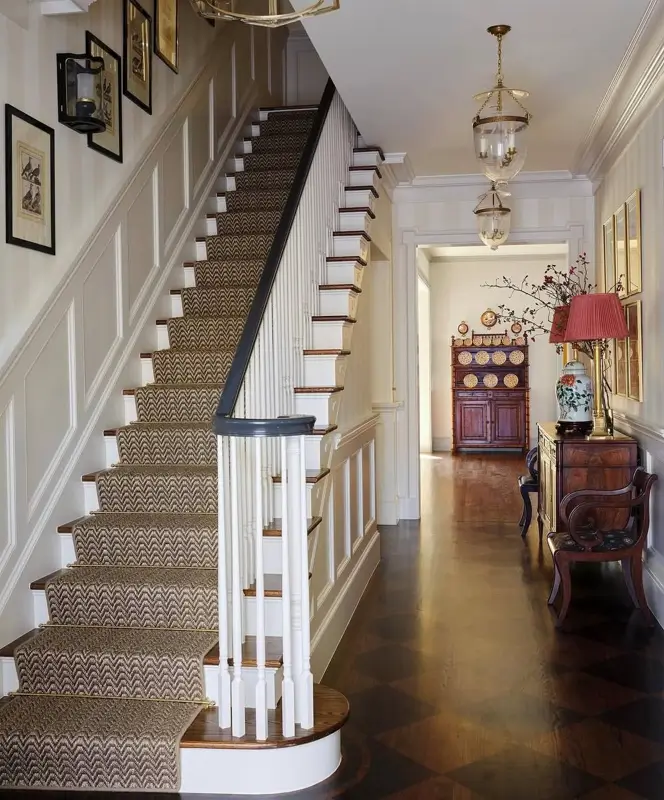
Symmetry and a central staircase sit at the heart of formal Colonial homes, and they’re the bones I protect first on any project. On this landing, raised-panel wainscoting climbs beside a patterned runner, while mahogany antiques and a bell-jar lantern carry the hall back through the house. Properly grand, yet still livable.
6. Green Paneled Foyer
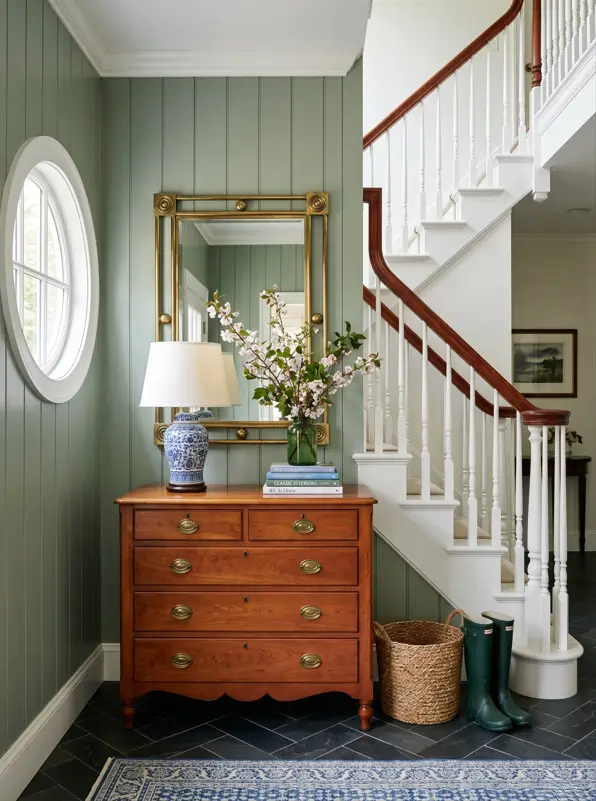
Vertical green paneling and a fine antique chest make an entry feel grounded the moment you walk in. I’d style the top just like this — brass bail pulls, a blue-and-white ginger-jar lamp, a stack of design books beneath a gilt mirror, with the turned-baluster staircase rising beyond. Effortlessly put-together.
7. Scenic Mural Dining Room
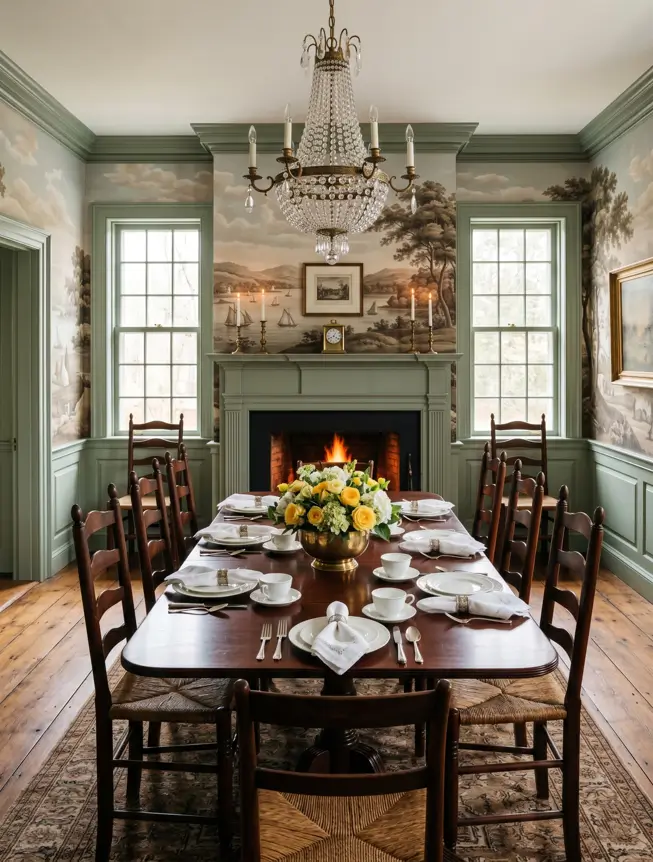
A hand-painted scenic mural is about as quintessentially Colonial as a room gets, and I never tire of them. Set between two windows, a symmetrical mantel anchors the wall, while mahogany ladder-back chairs and wide-plank floors carry the period feel right through. To me, this is a room made for long, candlelit dinners.
8. Formal Colonial Parlor
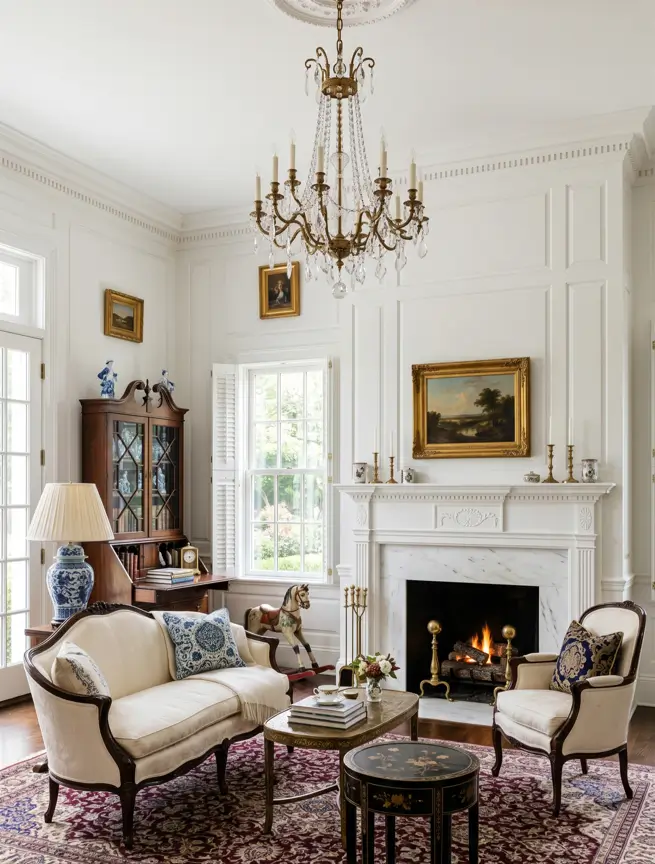
Raised-panel walls and a carved marble mantel give a formal parlor its sense of occasion, and I lean on both when a room needs gravity. Antique settees, a glass-front secretary, and a gilt landscape oil gather around the fire, with blue-and-white porcelain and a rich Persian rug layered in. Grand, but never cold.
9. Symmetrical Sitting Room
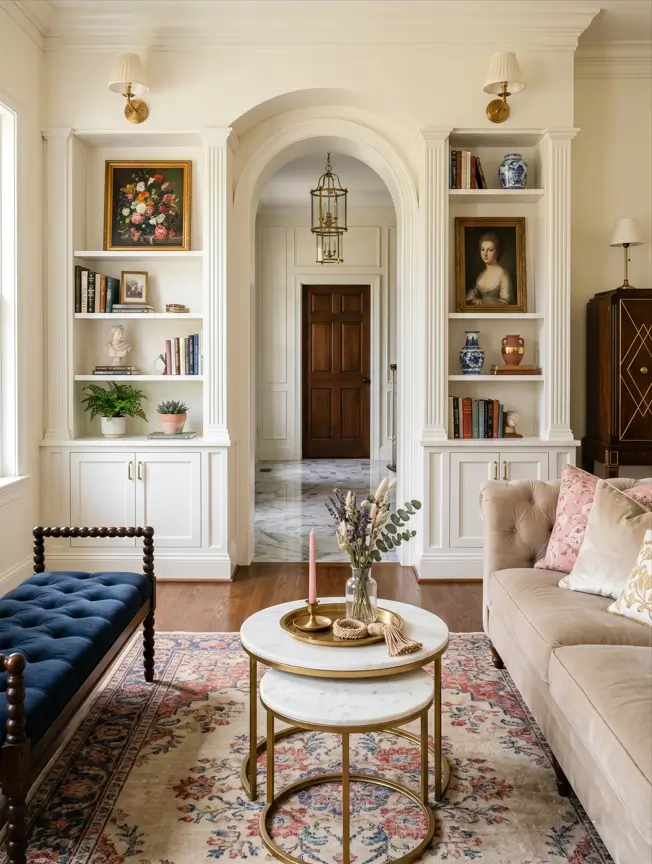
Matching built-in bookcases framing an arched doorway capture the balance I’m always chasing in Colonial rooms. Fluted pilasters, a six-panel door, and brass sconces hold the symmetry, while a portrait oil, blue-and-white jars, and a tufted bench keep it personal. Just beyond, a marble checkerboard floor catches the eye. Polished and inviting.
10. Moody Music Corner
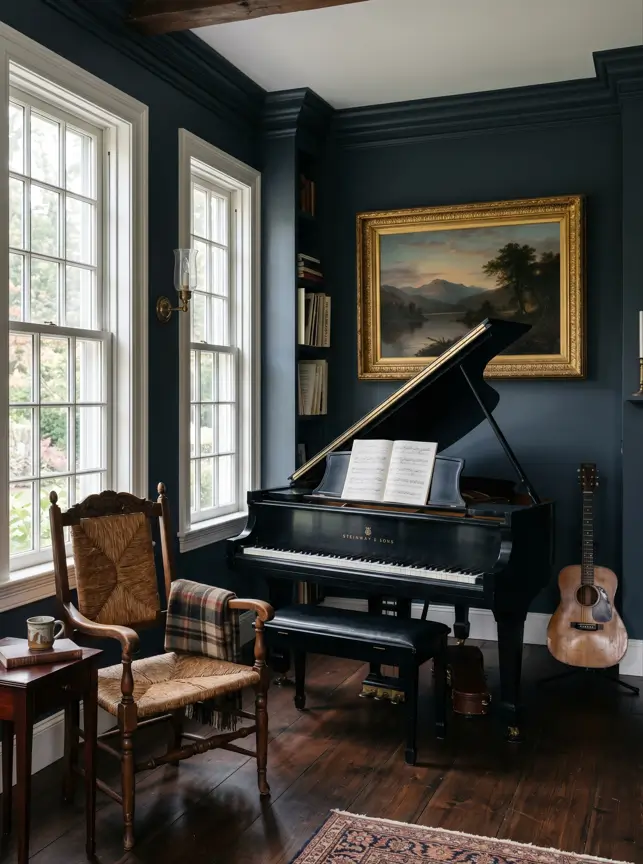
Deep blue walls and crown molding turn a quiet corner into a proper music room, and it’s the sort of moody scheme I love specifying. A gilt landscape oil hangs above the grand piano, while an antique rush-seat chair, beamed ceiling, and wide-plank floors keep the character intact. Displaying instruments is a tradition I think worth keeping. Full of soul.
Colonial Color Palettes
Colonial color palettes fall into two clear directions. American Colonial leans on soft, muted shades — creamy whites, warm yellows, muted blues, and sage greens — close to a neutral living room palette, with the occasional navy or brick red for contrast. British Colonial keeps things lighter and cooler, with pale walls grounded by dark wood and lifted with blue, green, and brass.
Both share the same trick, and it’s one I repeat to clients constantly: keep the walls quiet, and let wood, pattern, and a few collected pieces bring the warmth. The rooms that age best are the ones where the life comes from everything placed against the walls, not the walls themselves.
11. Blue Formal Dining
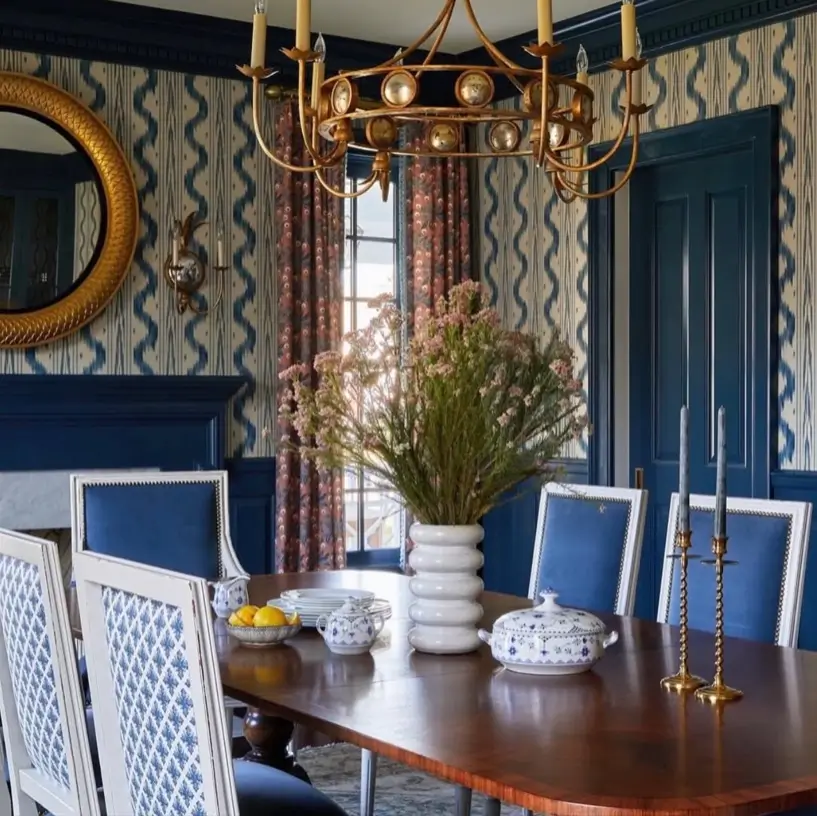
Deep blue paneling gives a formal dining room real presence without going dark, and I reach for it when a client wants drama that still feels classic. A mahogany pedestal table meets a gilt convex mirror and a stack of blue-and-white china, with brass candlesticks pulling the table together. Bold, but never busy.
12. Blue-and-White Kitchen
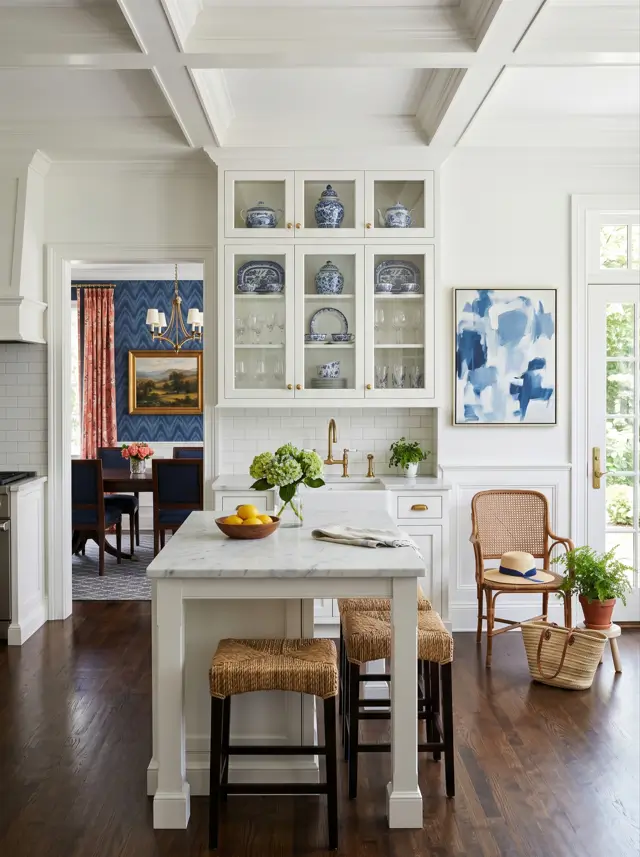
Glass-front cabinets filled with blue-and-white porcelain are one of the most recognizable Colonial signatures, and a kitchen color combination I use constantly. Throughout this kitchen, a coffered ceiling and raised-panel wainscoting hold the formal line, while cane and woven seating loosen it up. The blue dining room beyond ties it together. To my eye, endlessly classic.
13. Warm Yellow Living Room
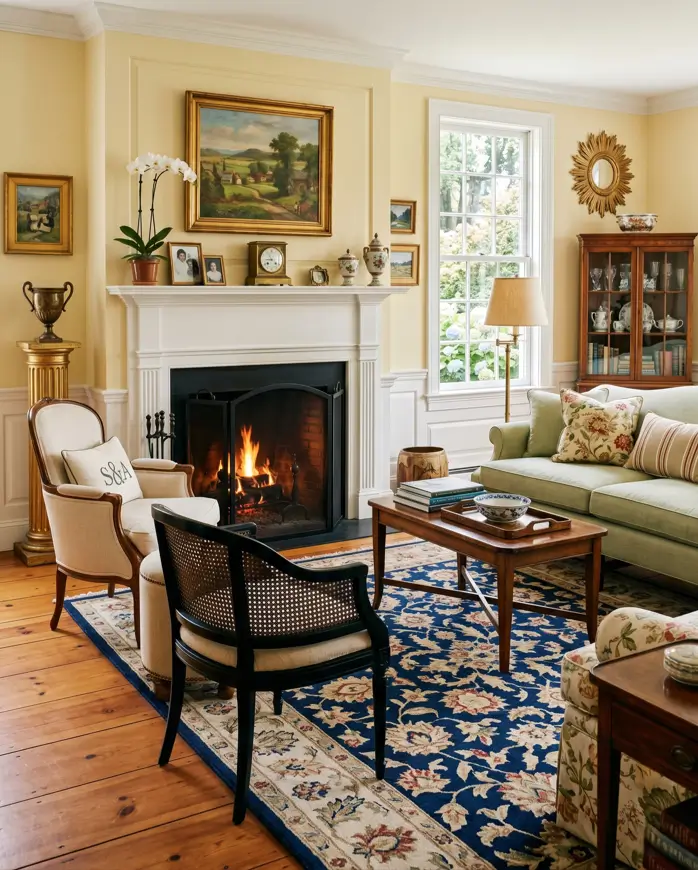
Soft yellow walls give a Colonial living room that sunny, lived-in warmth without losing any formality, and I find them quietly underrated. A white painted mantel, a classical landscape oil, and a glass-front bookcase set the tone, while wide-plank pine floors and a blue Persian rug carry the history underfoot. Easy to settle into of an evening.
14. Buttery Yellow Parlor
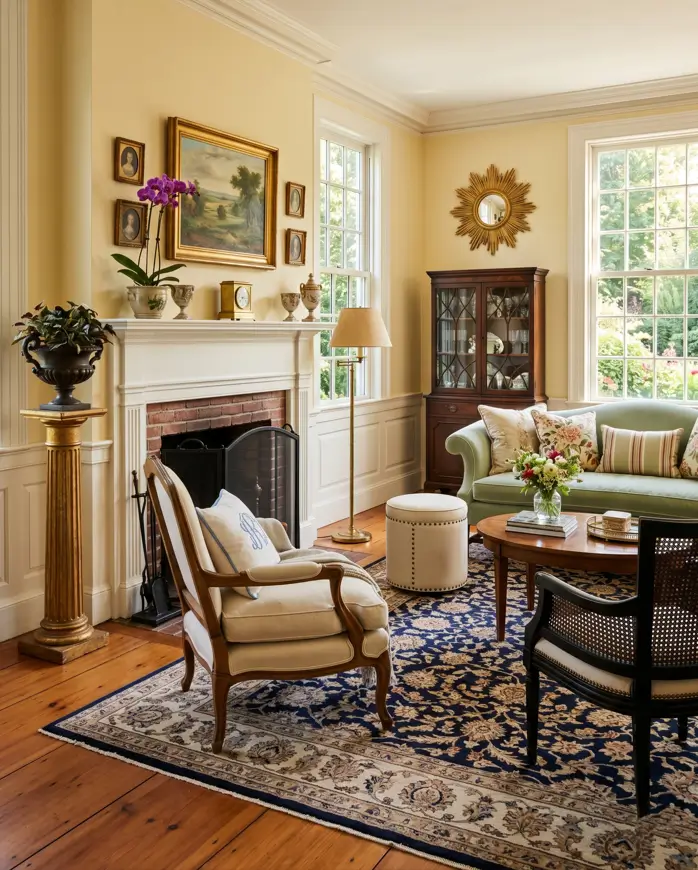
Buttery yellow and crisp white millwork feel both formal and welcoming, a balance I enjoy striking in Colonial rooms. A white mantel over red brick anchors the space, while a glass-front china cabinet, a gilt sunburst mirror, and antique portraits layer in the history. The navy Persian rug grounds it all. A lovely room to sit in.
15. Sage Green Kitchen
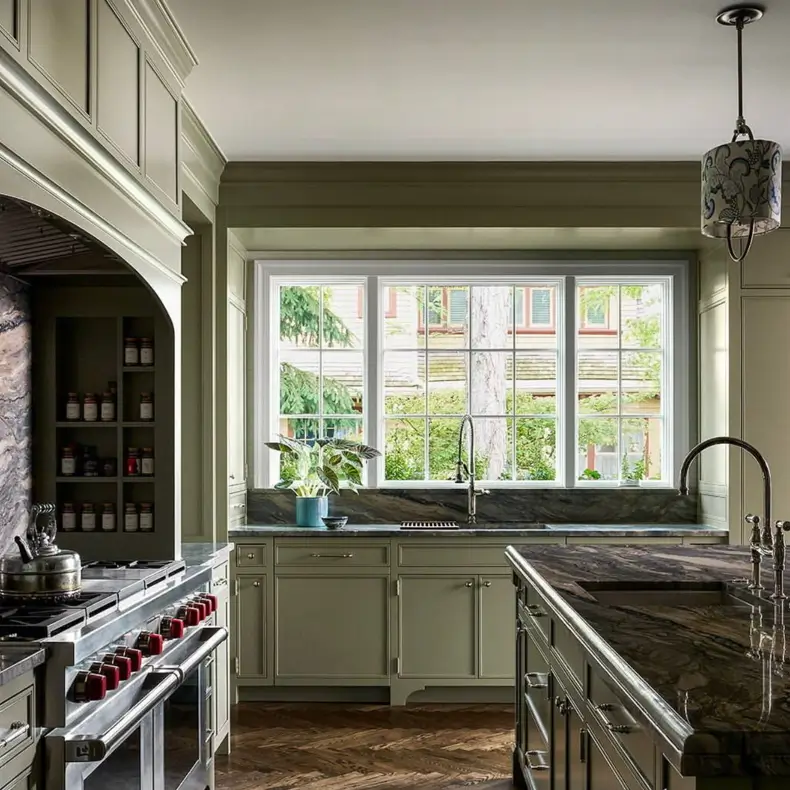
Muted green cabinetry is a quietly traditional choice that suits Colonial kitchens beautifully, and one of the green interior paint colors I recommend most often. Raised-panel doors, crown molding, and an arched niche give this room its formal structure, while multi-pane windows and a herringbone floor root it in the period. The stone countertops bring it firmly into today.
Colonial Furniture and Materials
Colonial furniture is sturdy, made of natural wood, and built to last and be passed down. Dark species like mahogany, teak, oak, and pine form the backbone — pedestal tables, glass-front cabinets, four-poster beds — alongside rattan and cane, leather, brass, marble, and antique pieces with real age.
In my experience, the surest sign of a good Colonial room is that nothing feels too precious to touch — the wood has a few marks, the rug is a little faded, and that’s exactly what makes it feel like home.
16. Paneled Fireside Study
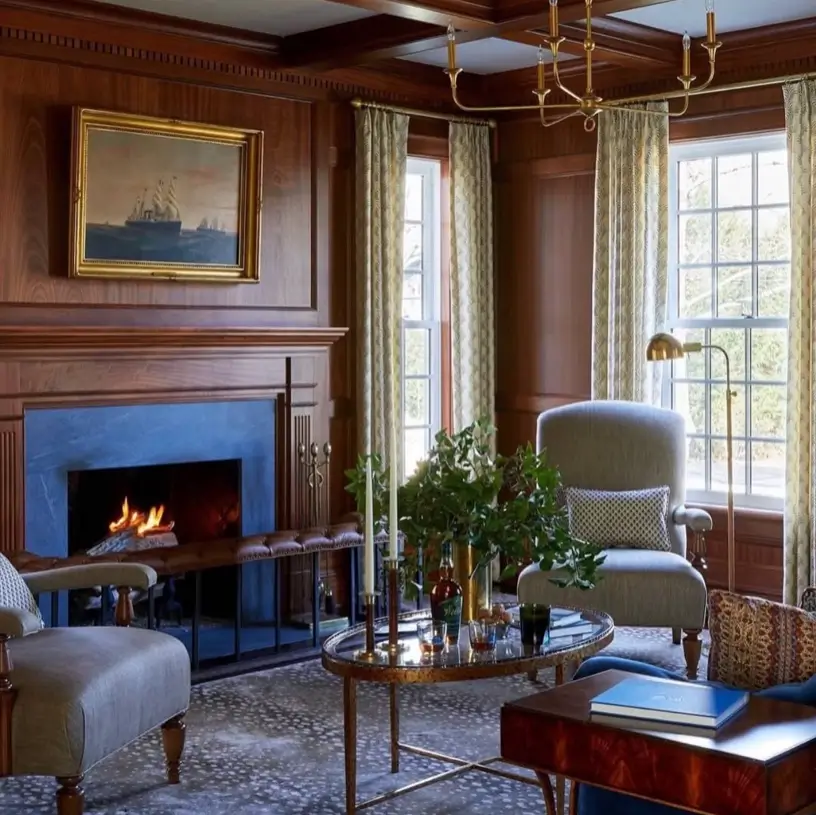
Wood-paneled walls and a coffered ceiling make a room feel instantly settled, and a study is where I most like to use them. Against the slate fireplace, a maritime oil and a tufted leather bench nod to the old seafaring side of Colonial homes, while linen chairs keep it comfortable. The kind of room I could happily disappear into.
17. Mahogany Study Library
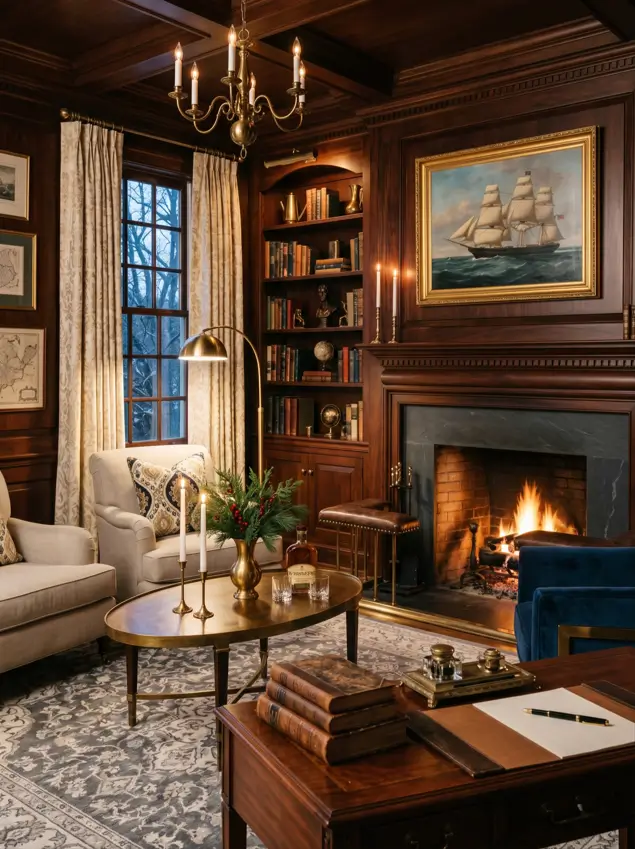
Floor-to-ceiling mahogany paneling turns a working study into the heart of a Colonial home, and few rooms give me more pleasure to design. Built-in bookcases, a leather-topped desk with a brass inkwell, and a clipper-ship oil over the fire speak to the old love of books and travel. Lit by candlelight, it feels deeply lived-in.
18. Slate Blue Library
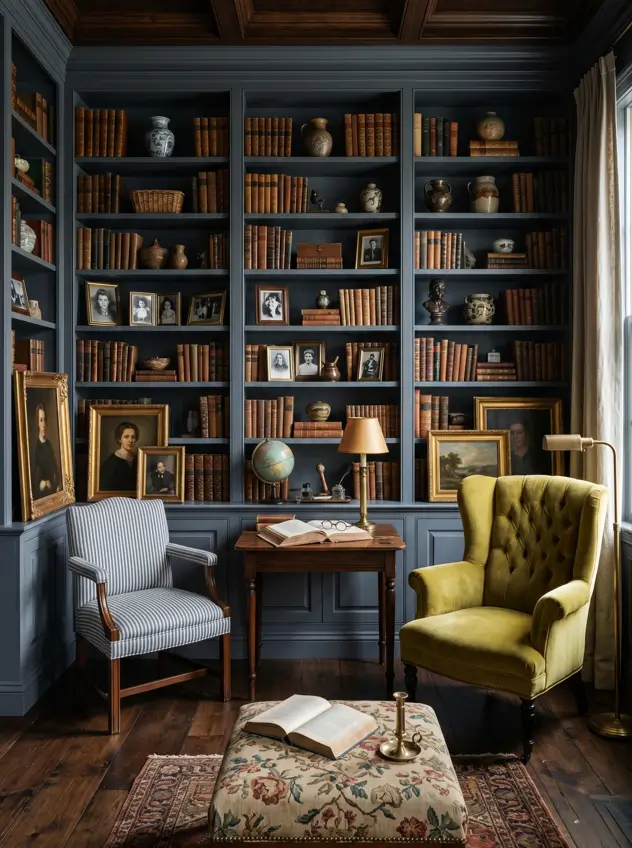
Built-in bookcases packed with leather-bound volumes give a Colonial library its bookish soul, and I always argue for keeping them open and full. Gilt-framed portraits lean against the shelves, a globe and writing table invite a quiet hour, and a mustard wing chair adds a jolt of warmth. Layered over years, it feels wonderfully personal.
19. Built-In Wet Bar
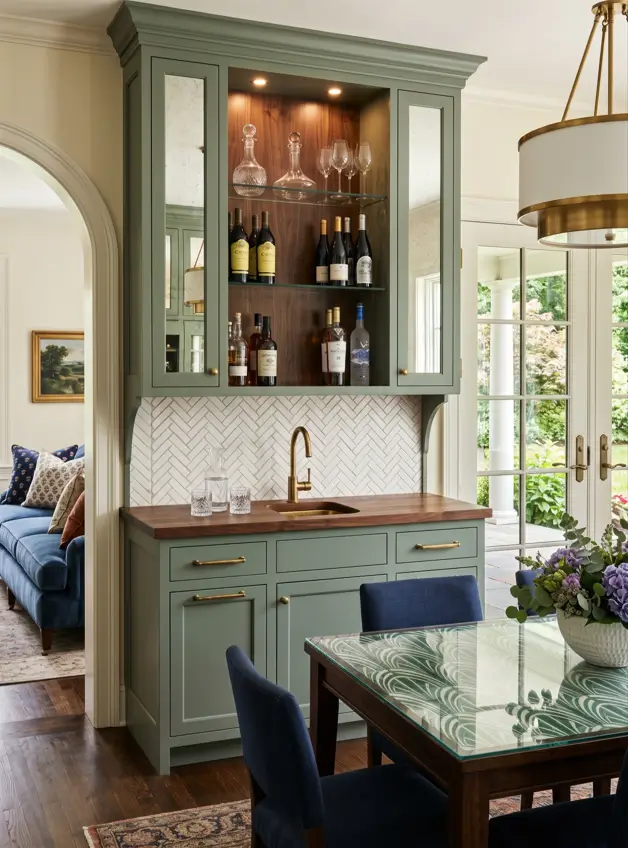
Tucked-in cabinetry like this nods to the old Colonial habit of giving everything its proper place, which is how I like a home to function. Antiqued mirror doors and a walnut counter dress up a compact bar, while sage paneling and an arched opening tie it to the rooms around it. Brass fittings add the polish. A lovely thing to gather around.
20. Classic Colonial Kitchen
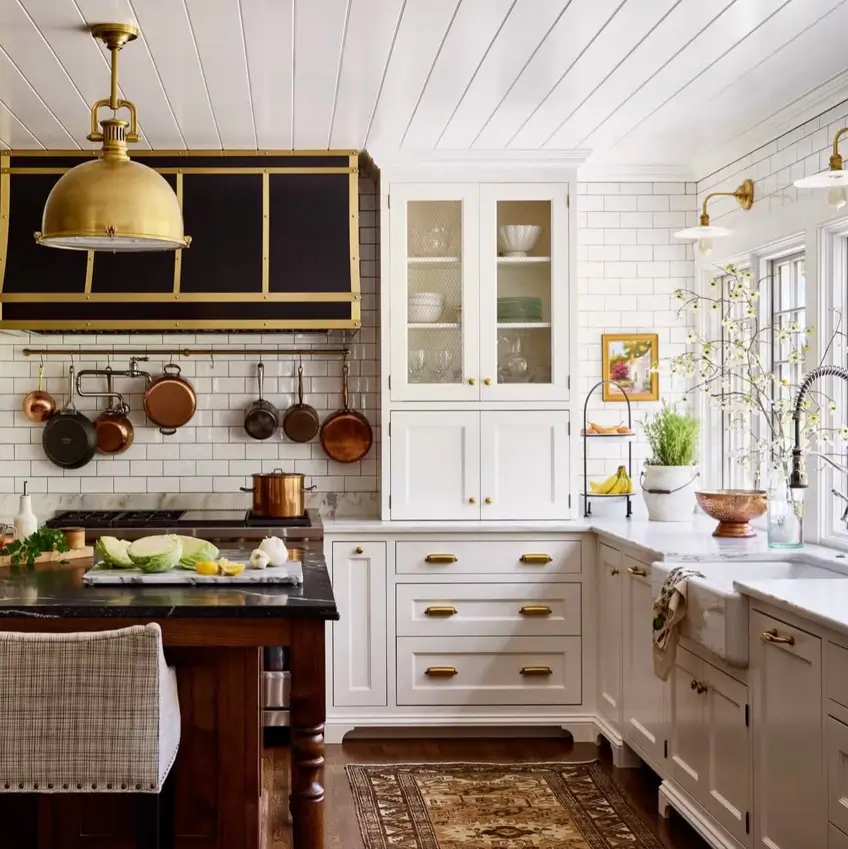
Built-in glass-front cabinetry brings the look of an old freestanding hutch right into the run of the kitchen, a detail I specify whenever there’s room. On the counters, copper pots and a worn runner soften the white shaker doors and brass cup pulls, while a turned-leg island grounds the space. A warm room to cook in.
Windows, Floors, and Architectural Details
The architecture is where Colonial style shows its quality — in the windows, the floors, and the millwork. Tall multi-pane double-hung windows are a signature, often paired with shutters, and floors are typically hardwood, laid straight in simpler homes and in herringbone, chevron, or wide planks in grander ones.
Add crown molding, wainscoting, and paneled doors, and the bones do half the work. You feel these details more than you notice them, and in older homes they’re the parts I always fight to keep — they’re nearly impossible to fake convincingly later.
21. Curved Staircase Landing
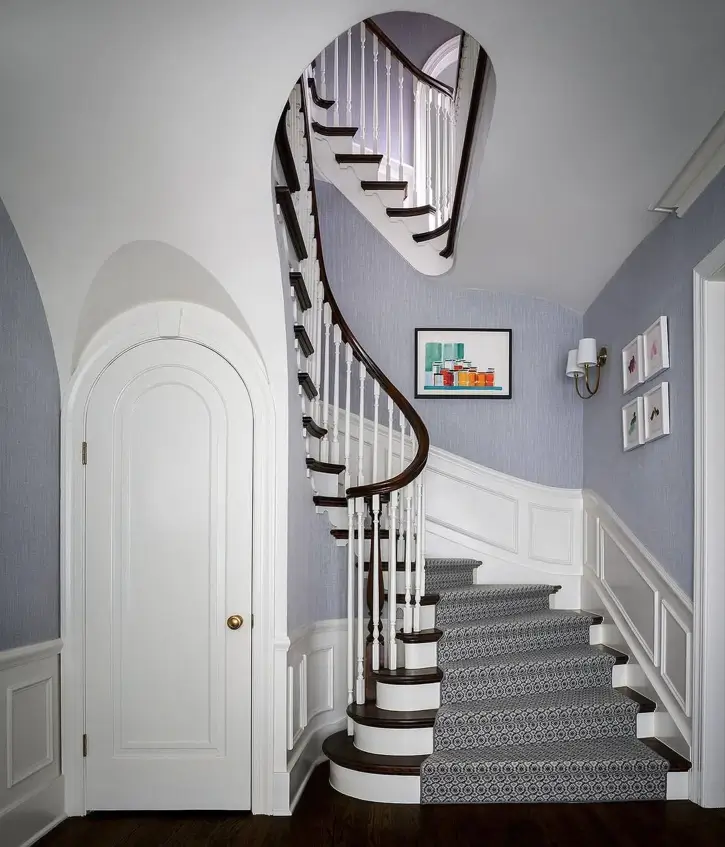
A curved staircase like this shows off the craftsmanship Colonial homes are known for, and it’s the first thing I’d preserve in a renovation. Dark mahogany handrails wind past white balusters and raised-panel wainscoting, while an arched paneled door tucks neatly into the wall. Soft blue grasscloth keeps the stairwell feeling fresh. A real showpiece.
22. Arched Pass-Through View
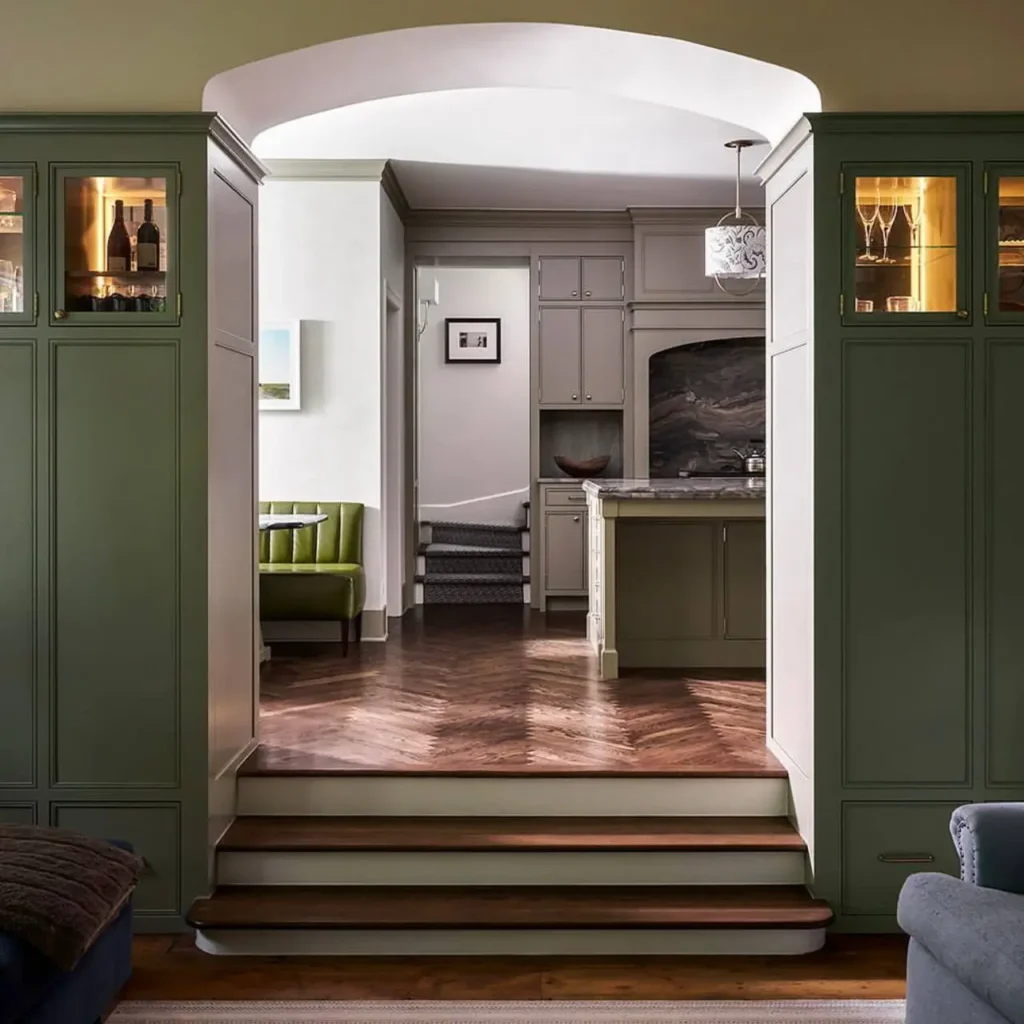
Barrel-arched openings between rooms are a graceful Colonial touch, and I use them to frame one space from the next. Glass-front built-in cabinetry flanks this passage, while herringbone floors run through to a staircase and range beyond. Green and greige paneling keeps it current. To me, a clever way to connect a home.
23. Traditional Marble Bath
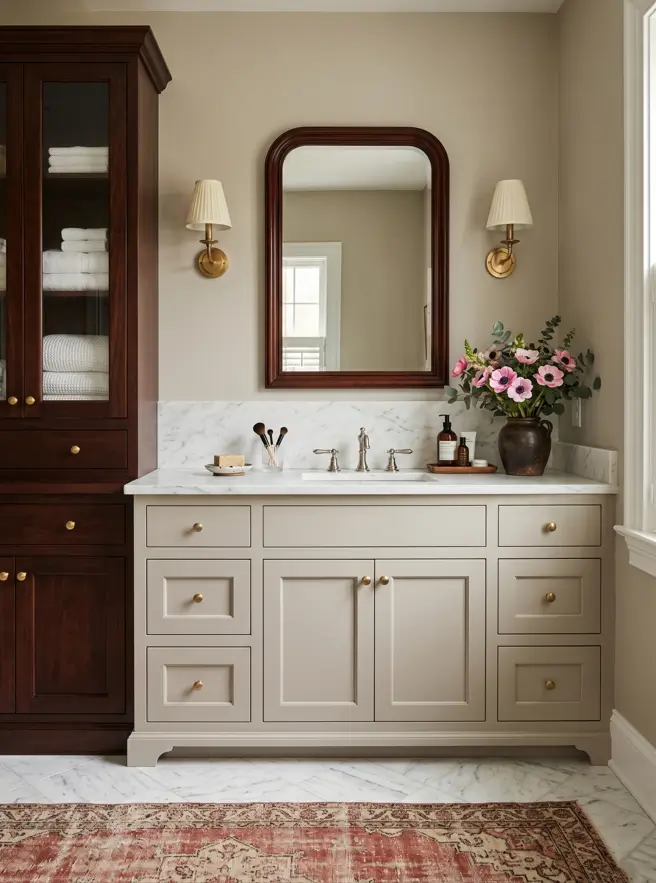
Dark wood and marble are a classic Colonial pairing that always feels considered, and one I return to in bathrooms. Flanking an arched mahogany mirror, pleated brass sconces and a tall glass-front linen cabinet bring real warmth, while the shaker vanity and a worn rug keep it from feeling too precious. A timeless way to do a bath.
24. Damask Clawfoot Bath
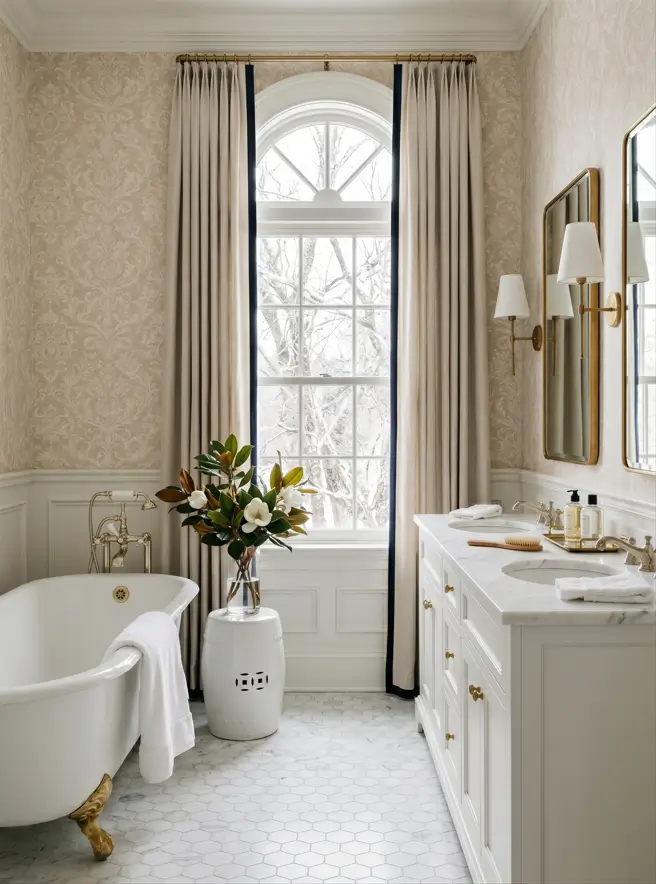
Damask wallpaper over crisp white wainscoting sets a refined, distinctly Colonial mood, and it’s a scheme I adore. A clawfoot tub on brass feet sits beneath an arched Palladian window, while a shaker vanity, marble hex floor, and a blue-and-white garden stool finish the room. The kind of bath I could linger in for an hour.
25. Serene Beadboard Bath
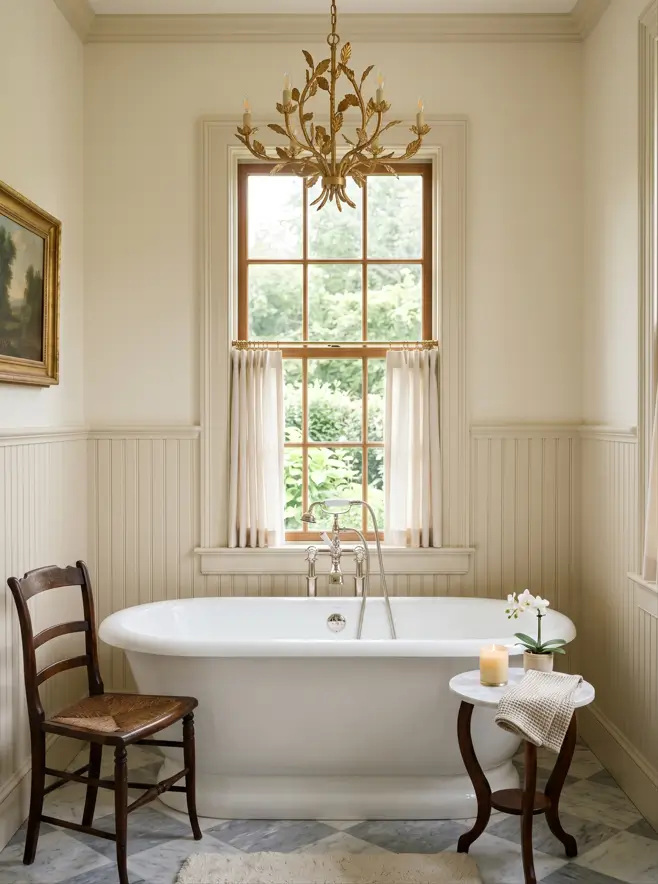
Cream beadboard and a marble checkerboard floor make for a calm, classic Colonial bath, and I often steer clients here when they want something soft. A freestanding tub sits squarely beneath a multi-pane window dressed in simple café curtains, while an antique chair and cabriole side table add quiet age. A gilt chandelier lifts it gently — the right lighting does a lot of quiet work in a Colonial room. Made for a long soak.
British Colonial Interiors: The Traveled, Tropical Look
British Colonial interior design is the warm, traveled side of the style, built around dark wood, natural texture, and a sense of faraway places brought home — the formality of classic British country houses, loosened up for a hot climate.
Mahogany and teak stand against crisp white walls, with rattan, cane, plantation shutters, and botanical prints filling in the rest — much of it descended from the Anglo-Indian furniture the British commissioned abroad.
The mood is collected rather than formal, like a home shaped by years of travel. In rooms I’ve styled this way, it usually comes together the moment the greenery goes in — a few plants beside all that dark wood, and the whole space breathes.
26. Botanical Powder Room
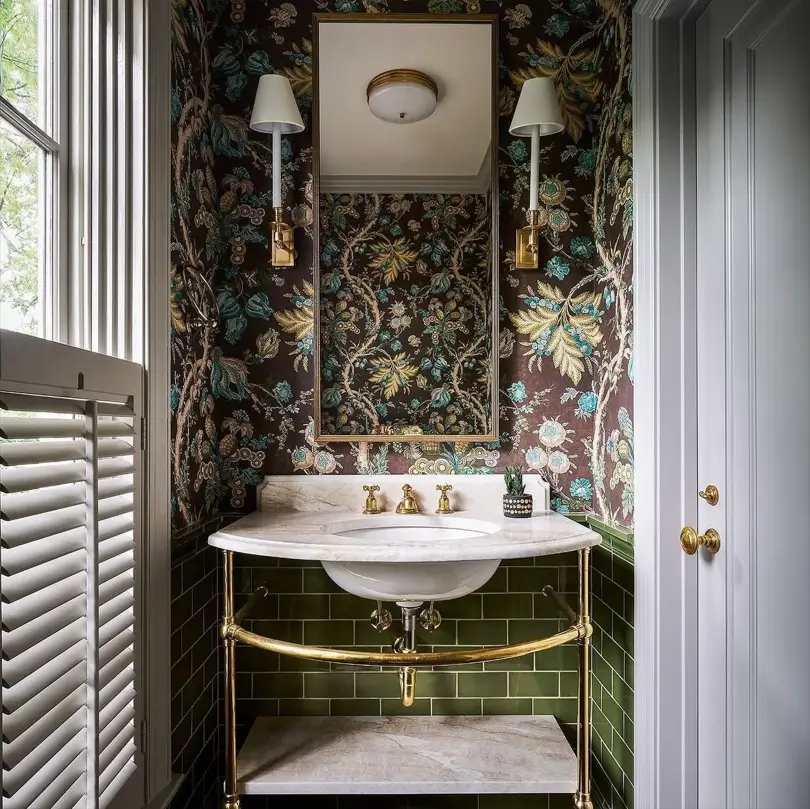
Dark botanical wallpaper instantly signals the British Colonial side of the style, and it’s a bold move I happily encourage in a small room. Set against green subway tile, a brass-leg washstand and twin candlestick sconces keep it glamorous, while plantation shutters filter the light. Small space, big personality.
27. Collected Bedroom Corner
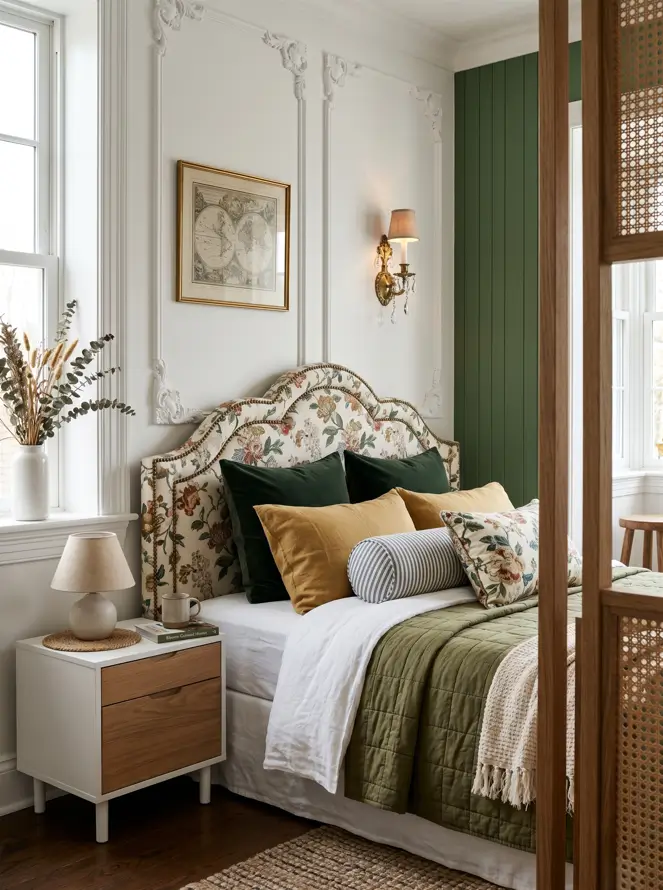
Layered florals and a nailhead headboard bring the gentle, traveled feel I look for in Colonial bedrooms. Notice the framed antique map, the crystal sconce, and the cane bed frame gathered against ornate molding, all softened with green and ochre linens. I’d slip in a modern oak nightstand without a second thought. Restful and full of character.
28. Faux-Bamboo Four-Poster
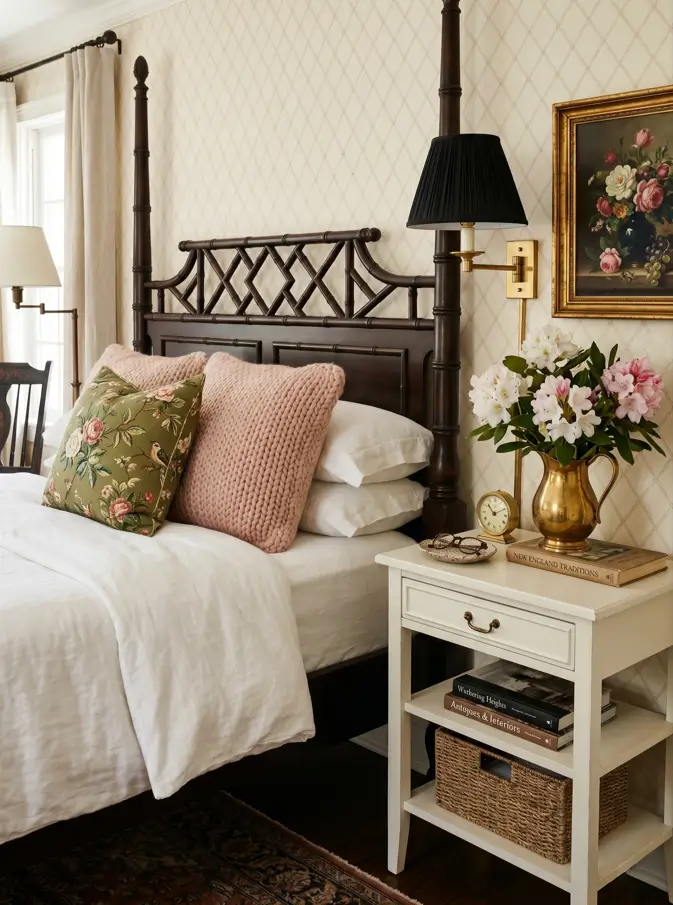
Faux-bamboo and fretwork carry the unmistakable stamp of British Colonial furniture, born of the empire’s love of travel, and they’re pieces I hunt for. A dark four-poster anchors the room, dressed with a floral-and-bird chintz pillow and a brass swing-arm sconce, while a gilt still-life and trellis wallpaper layer in old-world charm. Quietly romantic.
29. Grasscloth Powder Room
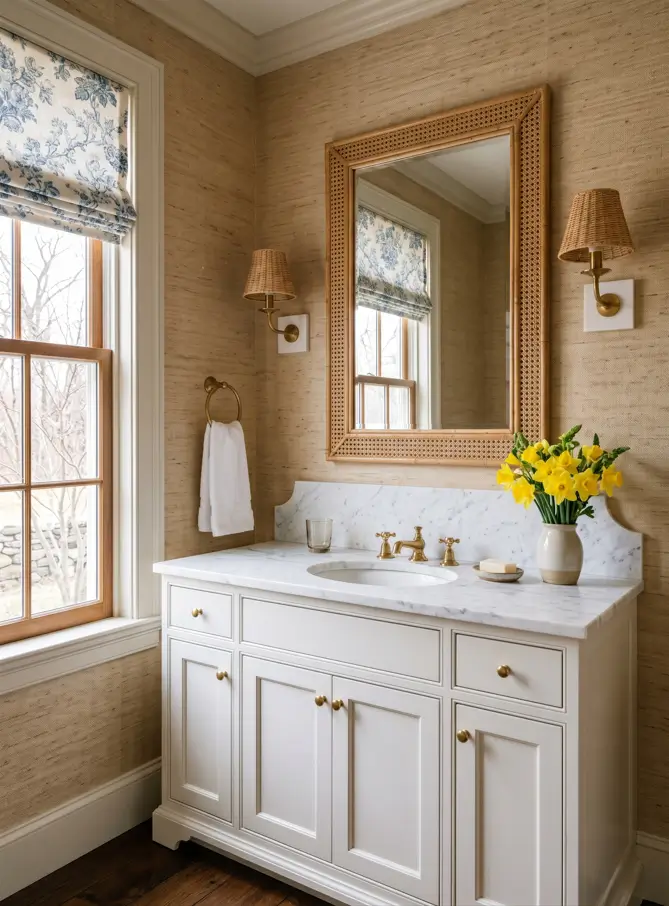
Natural grasscloth on the walls is a hallmark of British Colonial rooms, and I lean on it whenever a space needs warmth and texture. Set against it, a cane-framed mirror and wicker-shaded sconces lean into the look, while a marble vanity with brass fittings keeps things polished. A toile shade adds the final note. Texture done right.
30. Block-Print Rattan Bedroom
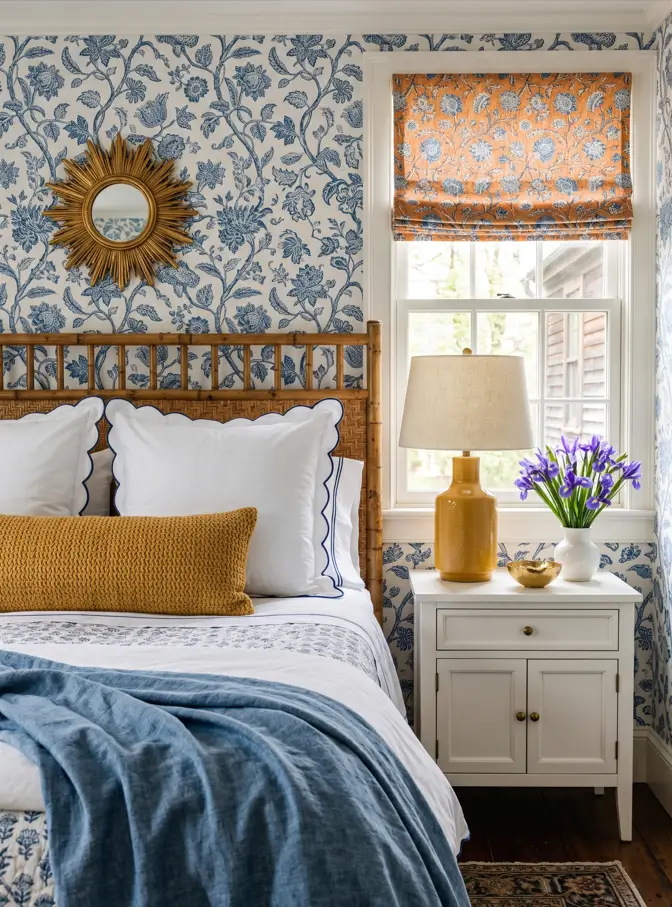
Rattan and faux-bamboo beds sit right at the heart of British Colonial style, and bringing that sun-warmed feel indoors is one of my favourite tricks. A caned headboard pairs with blue-and-white block-print wallpaper, while an Indian-print shade and a gilt sunburst mirror layer in pattern and shine. Cheerful and collected at once.
Colonial Style in a Modern Home
Colonial interior style works beautifully in a modern home, as long as you keep the bones and lighten the rest. It’s how I design the style for clients now: hold onto the things that make it Colonial — the molding, the dark wood, the symmetry, the collected antiques — then let the room breathe with cleaner-lined sofas, simpler window treatments, and a little more open space.
Done this way, an interior Colonial style reads classic rather than dated — the same balance I rely on when I update other period looks like modern Victorian interiors and Tudor interior design. The “is this too old-fashioned?” worry tends to fade fast once you see it in person: the history grounds the room, and the modern pieces keep it easy.
And if you’re weighing Colonial against other interior design styles, I’ve written companion guides to modern Mediterranean interiors, Japandi style homes, contemporary Scandinavian design, and Japanese home interiors — each one a different take on making a period or regional look feel current.
31. Dramatic Stair Hall
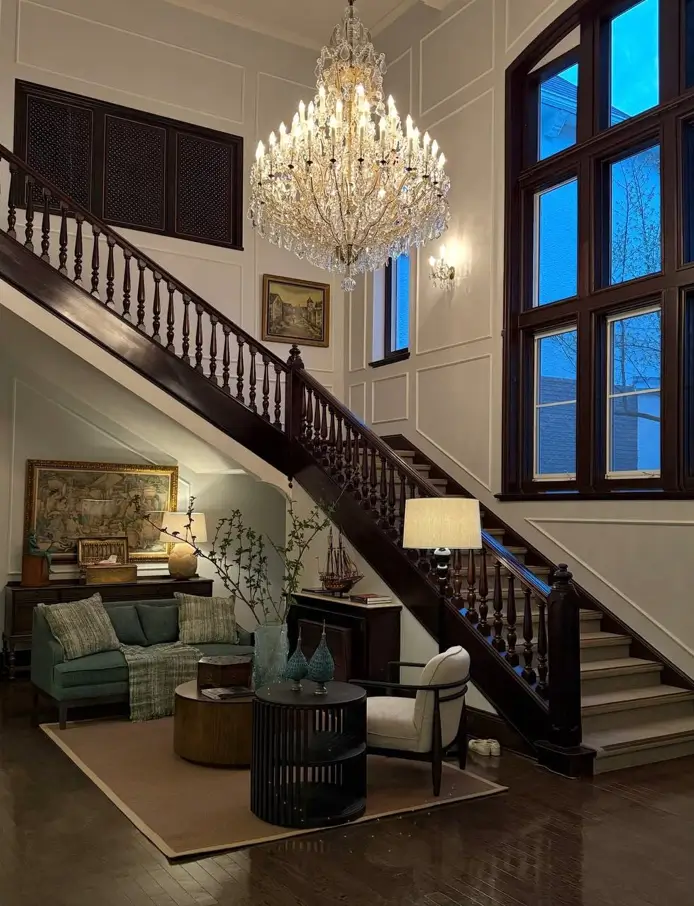
Dark turned balusters and a soaring stairwell give this hall real Colonial weight, the sort of drama I love to keep. Paired with a fretwork panel and antique chests, the dark wood does the heavy lifting, while a few modern chairs stop it feeling stiff. To me, quietly impressive.
32. Modern Colonial Living Room
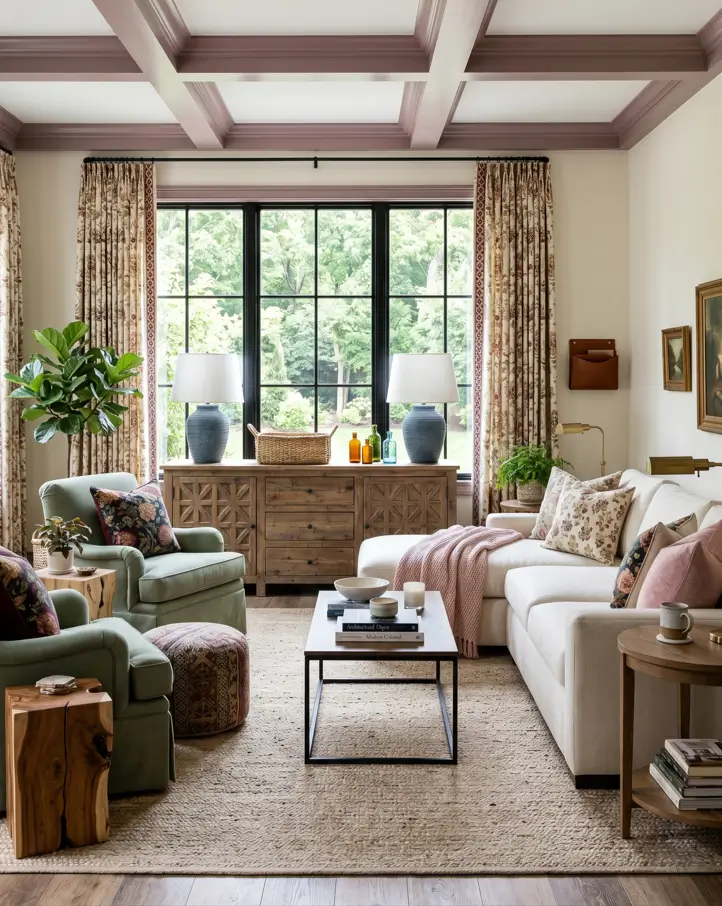
Coffered ceilings and floral chintz drapery root this room firmly in Colonial tradition even with modern pieces in the mix, and this blend is exactly how I work today. A fretwork-front sideboard, landscape oils, and blue ginger-jar lamps carry the heritage, while black-framed windows and a slim metal table bring it up to date. Proof the style still lives easily now.
33. Pastoral Landscape Bedroom
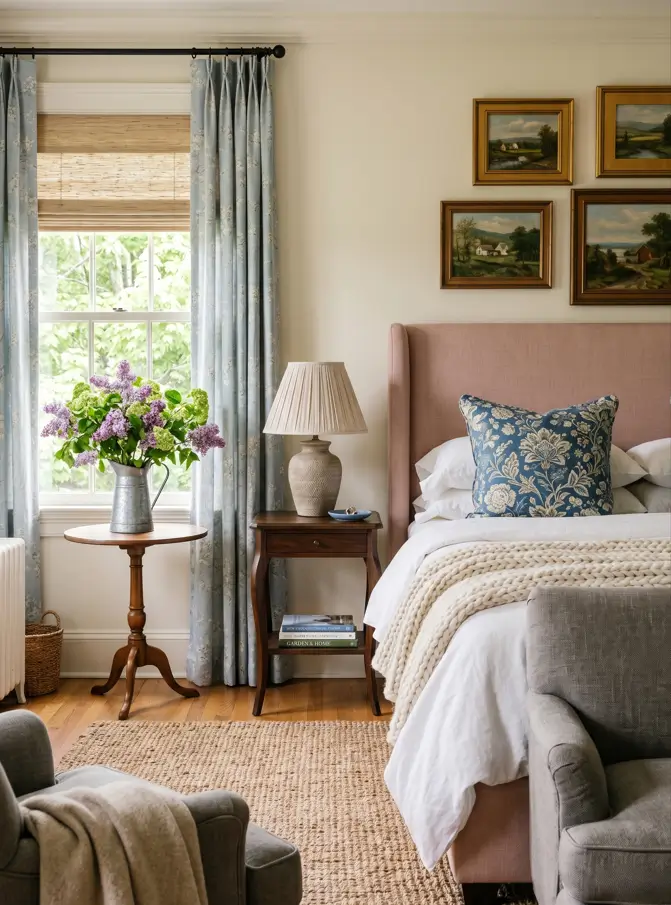
Grouped landscape oils in gilt frames give a bedroom that collected, Colonial-parlor feeling I find so calming. An antique tripod table and cabriole nightstand carry real age, while blue florals and a pleated lamp keep the palette soft. A linen headboard and knit throw bring it gently up to date — the makings of a cozy bedroom you’ll linger in. Calm and easy to wake up in.
Frequently Asked Questions
Is Colonial style the same as Colonial Revival?
Not quite, though they’re closely related. True Colonial is the original early look, while Colonial Revival is a later, romanticized take from the late 1800s — the same symmetry and craftsmanship, softened for everyday living. In practice, most of the Colonial homes I’d point to today are really Revival at heart.
Can Colonial style work in a small home or apartment?
Yes — it often feels especially warm in a smaller space. You don’t need grand architecture, just a few good pieces: one antique wood item, a soft wall color, a worn rug, and a little blue-and-white porcelain. I’d keep the furniture sturdy but not oversized, and let a little symmetry guide the layout. Cozy and considered, never cramped.
What are the key features of Colonial interior design?
The defining features are symmetry, dark natural wood, and fine millwork like wainscoting and crown molding, plus multi-pane windows, a muted palette, and collected antiques such as blue-and-white porcelain. American Colonial leans formal and symmetrical; British Colonial adds rattan, cane, and tropical greenery. Whenever a room balances natural wood with classic proportion and a few aged pieces, I read it as Colonial.
Is Colonial style still popular in 2026?
Yes. It stays in steady demand, partly because Colonial and Colonial Revival homes make up such a large share of the housing stock, and partly because the look adapts so easily to modern living. The direction I’m seeing now is lighter — the same millwork, dark wood, and antiques, paired with cleaner-lined furniture and more open rooms.
About the Author: Naraphon Kanyawee