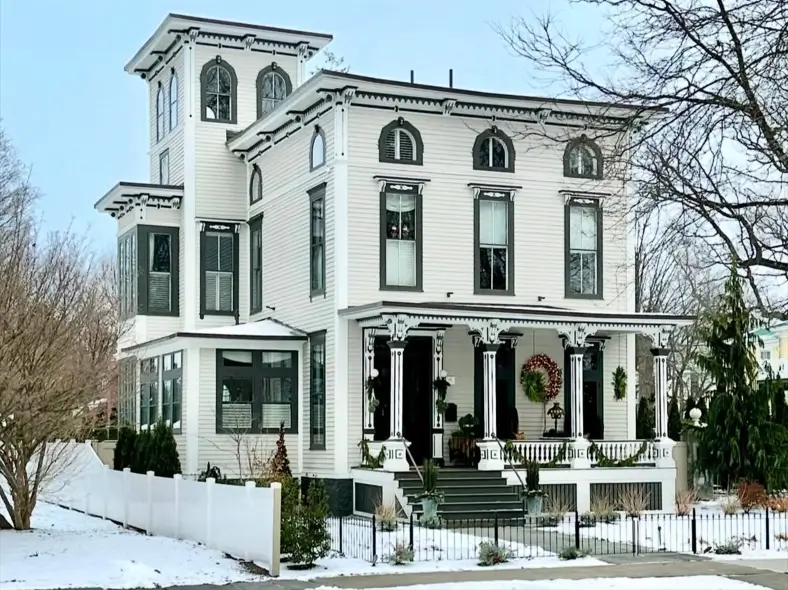

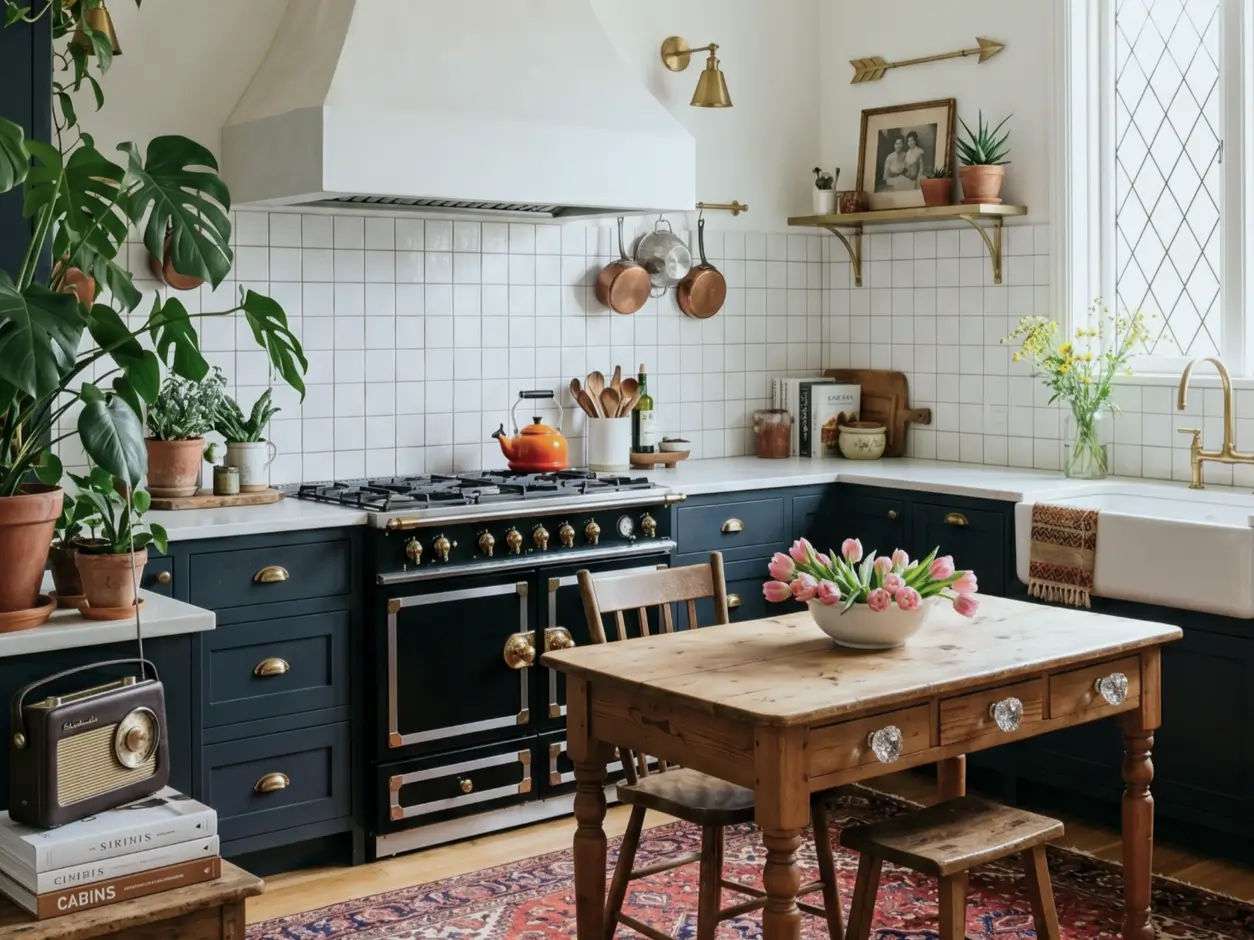
The short version: Victorian kitchen design is defined by deep, saturated colors, furniture-style cabinets, patterned tile floors, ornate detailing, and warm metals like brass and copper. The look works because it feels collected over time rather than installed in a weekend. You can lean fully historic or take the lighter “modern Victorian” route that keeps the period character but adds open layouts and more natural light.
Walk into a true Victorian kitchen and the room tells you how it wants to be used. The heavy iron range sits where everyone gathers. The glass-front cabinets show off everyday china instead of hiding it. Deep, settled colors wrap the walls, and the patterned floor underfoot has usually seen a century of footsteps. Victorian kitchen design has always been built for company, and somehow these rooms still carry that feeling today.
Seven years on site has taught me which of those old details earn their keep and which ones quietly need to go. What I keep coming back to with a Victorian style kitchen is how forgiving it is — the farmhouse sink, the dark cabinetry, the brass that dulls a little with age. None of it asks to be perfect, and a bit of wear only makes the room feel more like itself.
So here’s the honest version: the look I love, where it works, and the few places I’d gently point you elsewhere — not the museum-kitchen fantasy, but a room you can actually cook in.
What you’ll find in this guide
- What defines the style — the elements that make a kitchen read Victorian
- Cabinets, colors, islands, and tile — the four choices that carry the whole look
- Modern Victorian kitchens — how to get the character without the museum feel
- Small and period kitchens — ideas for narrow, real-world spaces
- Lighting and finishing details — the affordable touches that shift a room
- Mistakes to avoid — the honest, designer’s-eye pitfalls
What Defines a Victorian Kitchen?
A Victorian kitchen is defined by warmth, ornament, and the sense that the room was furnished rather than installed. The style takes its cues from the Victorian era, roughly 1837 to 1901, when the kitchen was the working heart of the home. You’ll often see deep, rich colors, glass-front or furniture-style cabinets, patterned floor tiles, a freestanding range, and small touches of brass or copper that catch the light.
What sets a Victorian style kitchen apart from plain traditional design is the layering — nothing is meant to match perfectly. A painted dresser holds blue-and-white china, copper pans hang within reach, an old portrait leans against the backsplash.
The rooms I’ve worked in that get this right feel collected over years, not bought in a weekend. That lived-in quality is the whole point — the same warmth I look for in a Victorian style bedroom, just applied to the busiest room in the house.
Victorian kitchen design at a glance
| Element | What to look for |
|---|---|
| Colors | Forest green, navy, oxblood red, soft pink, charcoal, warm wood |
| Cabinets | Glass-front, raised-panel, freestanding dressers and larders |
| Floors | Encaustic tile, checkerboard, quarry tile, herringbone brick |
| Counters | Marble, butcher block, dark veined granite |
| Metals | Aged brass, copper, never shiny chrome |
| Signature pieces | Freestanding range, farmhouse sink, furniture-style island |
| Finishing touches | Chandeliers, pressed-tin ceilings, heritage wallpaper, framed art |
The rest of this guide walks through each of these in turn — starting with the cabinets, which do more to define the style than anything else.
Victorian Kitchen Cabinets: Glass Fronts, Dressers & Detailing
Victorian kitchen cabinets are known for their furniture-like detailing, glass fronts, and painted or natural wood finishes. Rather than a run of identical units, the era favored pieces that looked like standalone furniture — dressers, larders, and glazed cabinets built to display dishes rather than hide them. You’ll often see raised-panel doors, ornate cornices, and aged-brass cup pulls.
The detail I love most is the glass. Leaded diamond panes, reeded ribbed glass, or simple clear panes all turn everyday china into part of the decoration — in one kitchen I worked in, the owners’ inherited transferware behind leaded glass became the first thing every visitor noticed.
1. Leaded glass cabinets
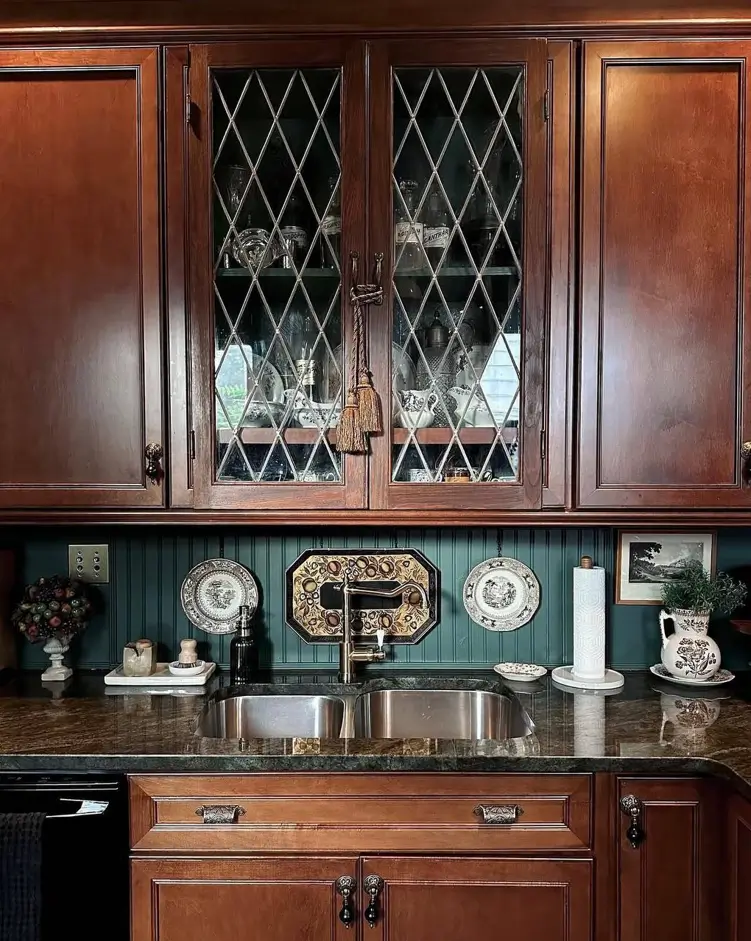
Leaded diamond-glass cabinet doors are one of the most recognizable Victorian details, used to show off glassware and china rather than hide it. Warm mahogany-toned wood, a green beadboard backsplash, ornate cup pulls, and blue-and-white transferware complete the picture here. This look feels rich without trying too hard.
2. Glass-front display cabinets
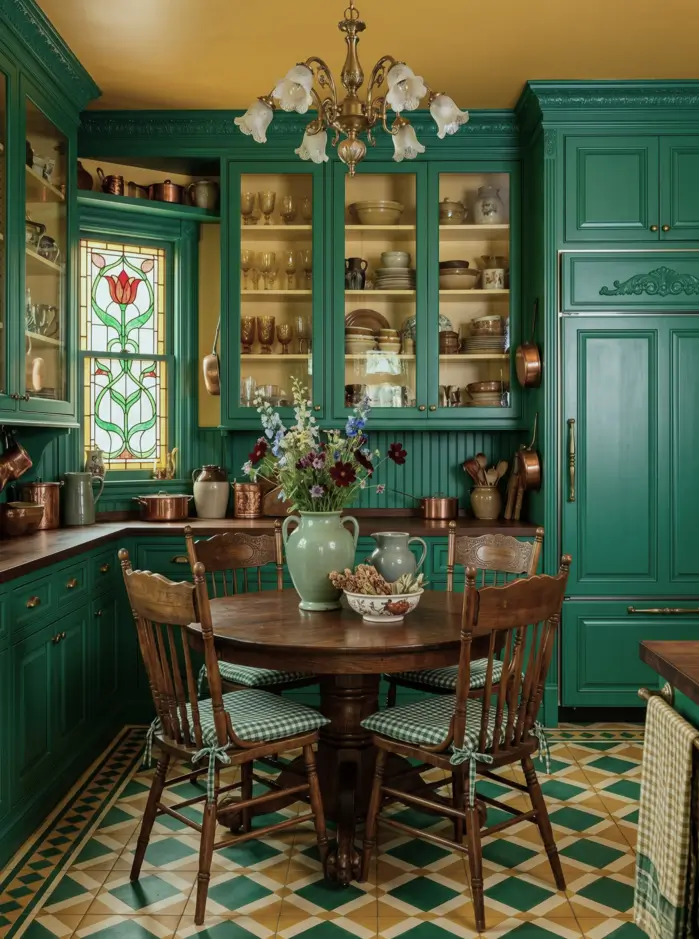
Floor-to-ceiling glass-front cabinets turn everyday dishes into part of the decoration, which is a very Victorian idea. Here emerald cabinetry holds amber glassware and stoneware behind glazed doors, lit warmly from within. A brass chandelier, tulip stained glass, and a checkerboard floor pile on the period charm. We love it.
3. Reeded glass fronts
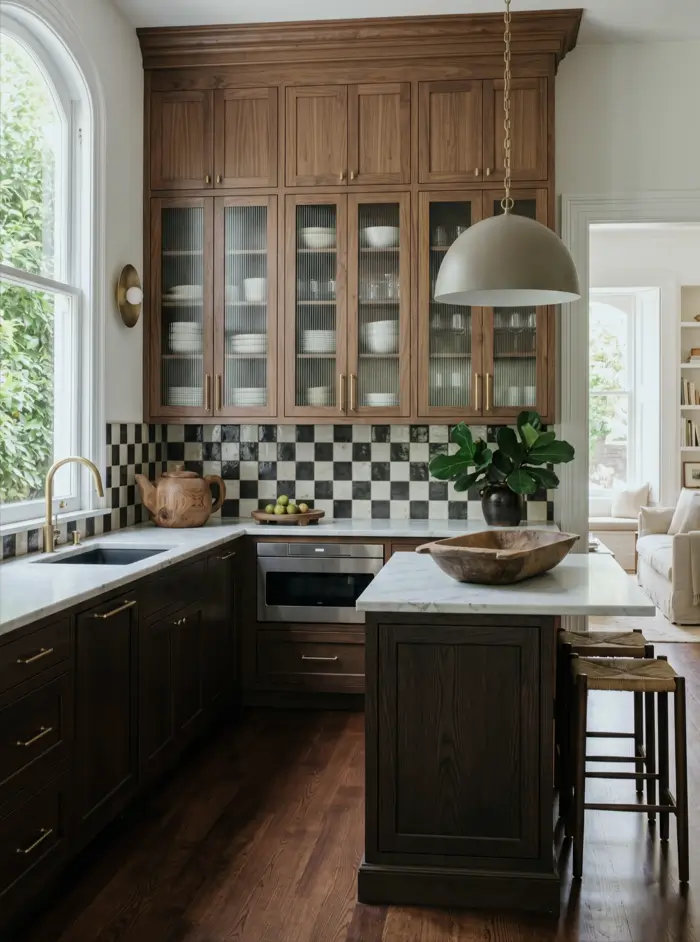
Reeded glass on the upper cabinets softens the view of what’s inside, a refined twist on the classic Victorian glass-front. Warm walnut cabinetry, a bold molded cornice, a checkerboard backsplash, marble counters, and brass bar pulls make it feel rich and grown-up. The fluted glass catches the light beautifully through the arched window.
4. Library ladder cabinets
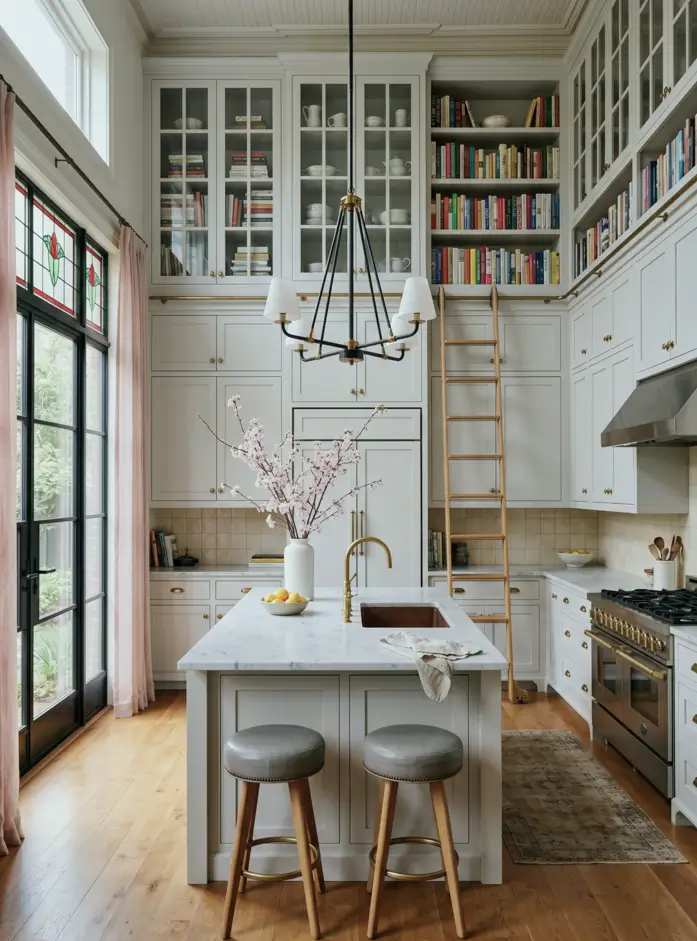
Tall ceilings are common in Victorian homes, and here floor-to-ceiling cabinets make the most of them, reached by a sliding library ladder. Glass-front uppers hold books and china above greige cabinetry, with brass cup pulls, a marble island, and a stained-glass door. Running storage right up to the ceiling feels both practical and grand.
5. Unfitted pine dressers
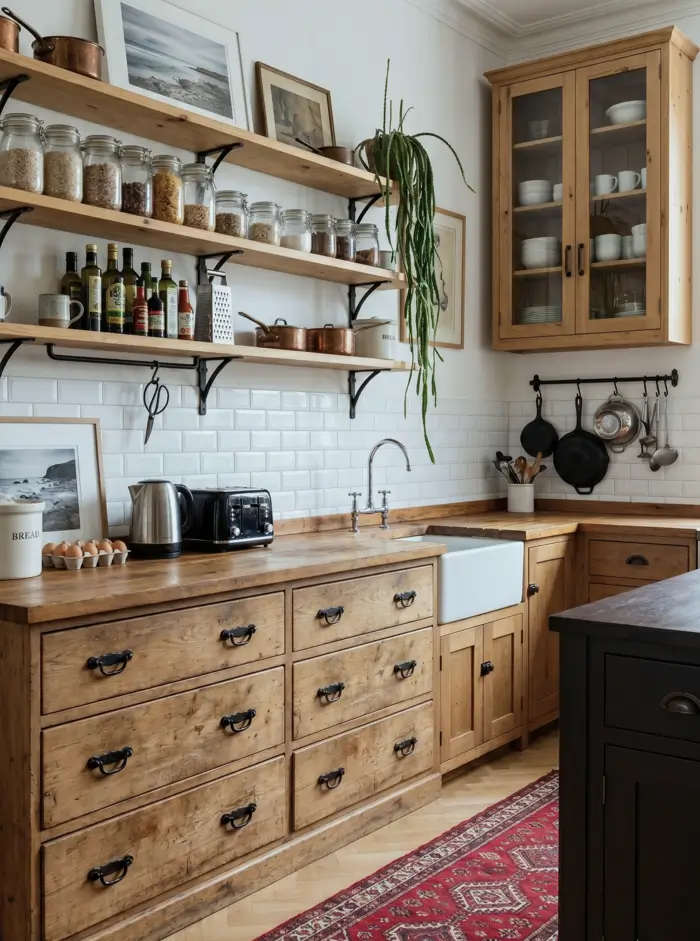
Rather than fitted units, this kitchen is built from freestanding pine pieces, much the way a Victorian scullery would have been furnished. A deep bank of dresser drawers with black bin pulls, a glass-front cabinet, a butler’s sink, and open shelves of storage jars carry the look. The unfitted feel gives it real character.
6. Painted Welsh dresser
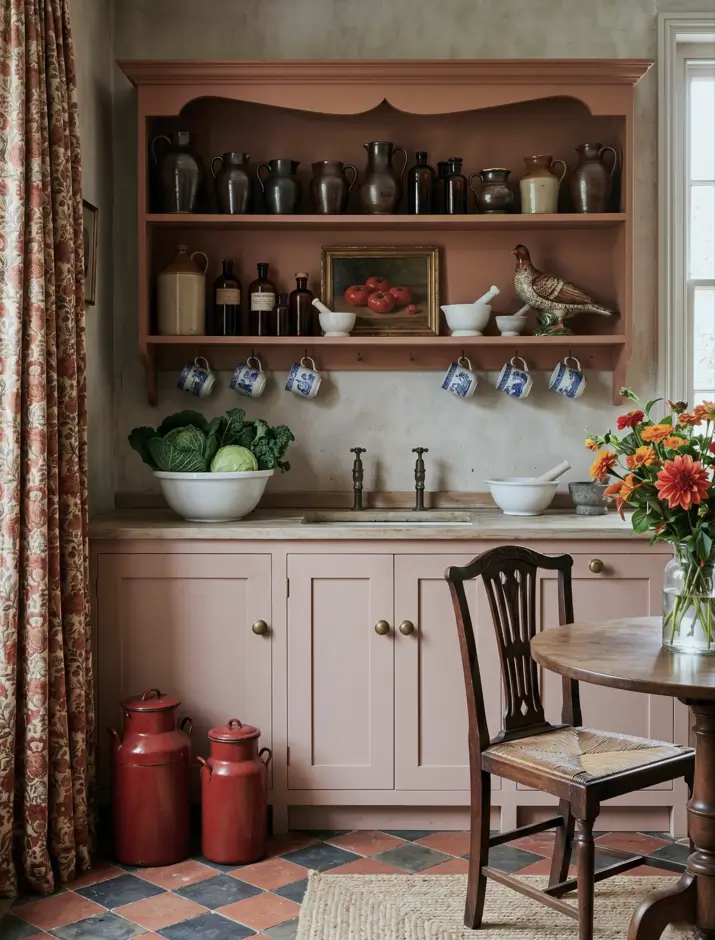
A built-in painted dresser, its shaped top lined with cup hooks and stoneware jugs, is about as Victorian as a kitchen wall gets. Here a dusty terracotta-pink finish, blue-and-white transferware, separate brass pillar taps, and a red-and-slate quarry-tile floor complete the period picture. Nothing matches exactly, and that’s the charm.
7. Glazed display dresser
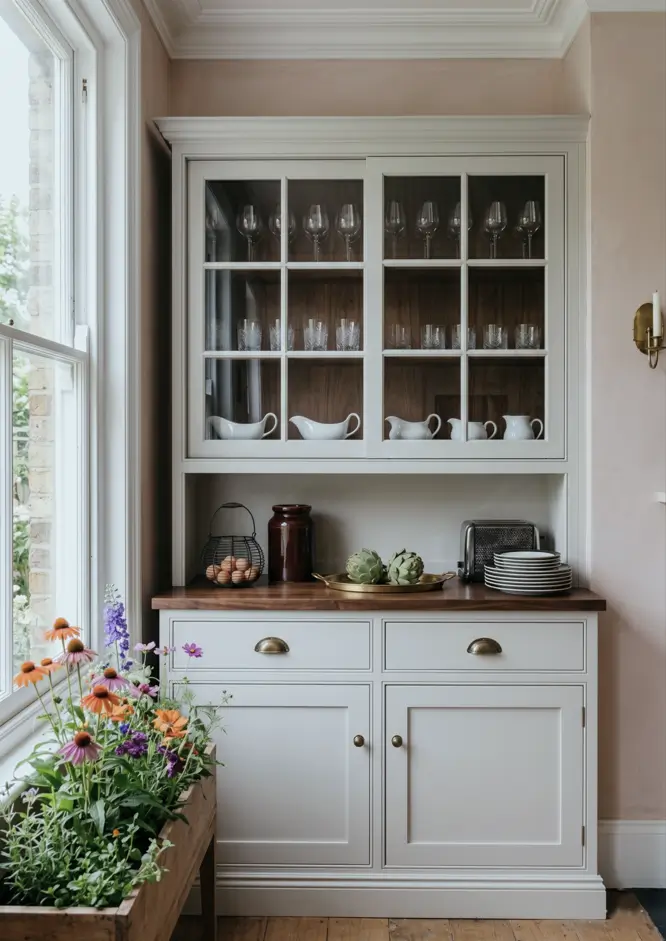
Few pieces anchor a kitchen like a built-in glazed dresser, its glass-paned doors showing off glassware and white ironstone jugs against a warm walnut interior. Soft greige cabinetry, brass cup pulls, a walnut worktop, and a molded cornice keep it gentle and refined. It’s the sort of piece that quietly anchors a whole kitchen.
Victorian Kitchen Colors: From Forest Green to Soft Pink
Victorian kitchens lean on deep, saturated colors: forest green, navy, oxblood red, soft pink, charcoal, and warm natural wood. The era was never shy about color, partly because dark tones hid the soot and coal dust of a working kitchen. Today those same shades read as cozy and grounding, especially against brass hardware and marble.
A quick word of honest advice: the all-white “modern Victorian” kitchens you see everywhere can look lovely, but real Victorian rooms used color generously. If you want the look to feel authentic, don’t be afraid of a dark cabinet. I once talked a nervous client into a deep green against her instincts, and it’s the part of her kitchen she now loves most.
8. Forest green cabinets
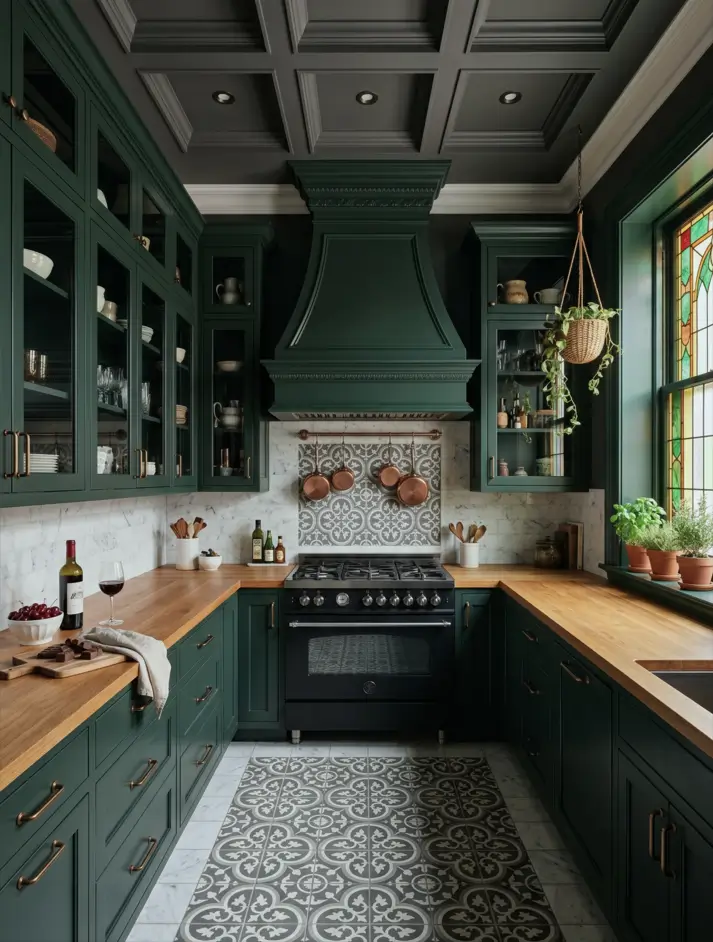
Deep forest-green cabinets give this Victorian kitchen its drama, grounded by a coffered ceiling and an ornate molded hood. Encaustic-pattern floor and backsplash tile, a stained-glass window, copper pans, and aged-brass handles fill out the era beautifully. The dark color reads moody rather than heavy.
9. Navy blue cabinets
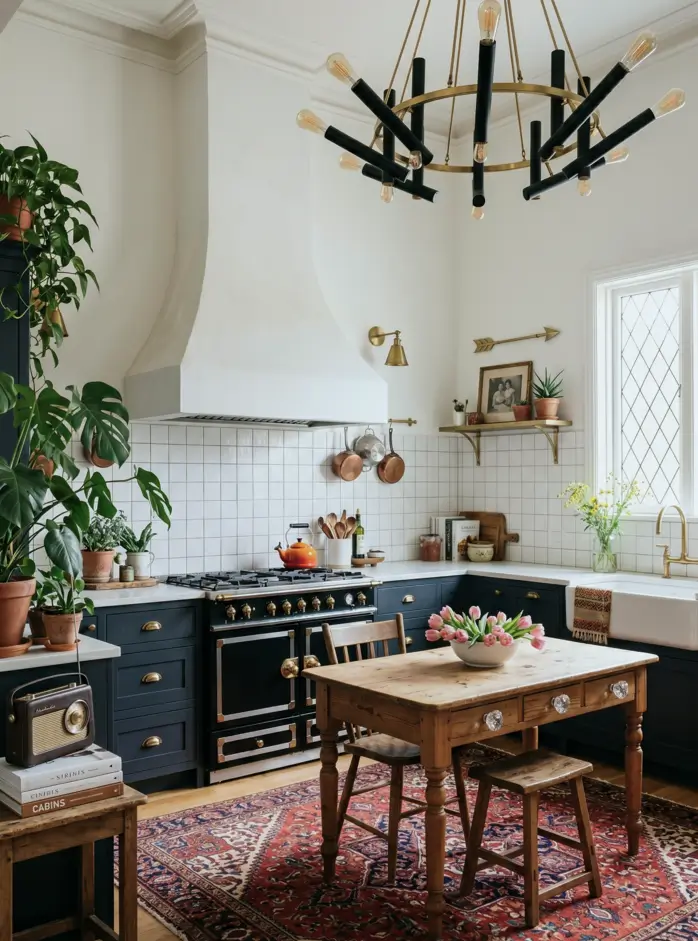
Instead of green, this kitchen reaches for deep navy cabinets, a quieter but equally Victorian choice. A black-and-brass range cooker anchors the wall beneath a sculptural plaster hood, with brass cup pulls, a leaded diamond window, copper pans, and a pine table softening it. The layered rug pulls the warmth together.
10. Charcoal grey cabinets
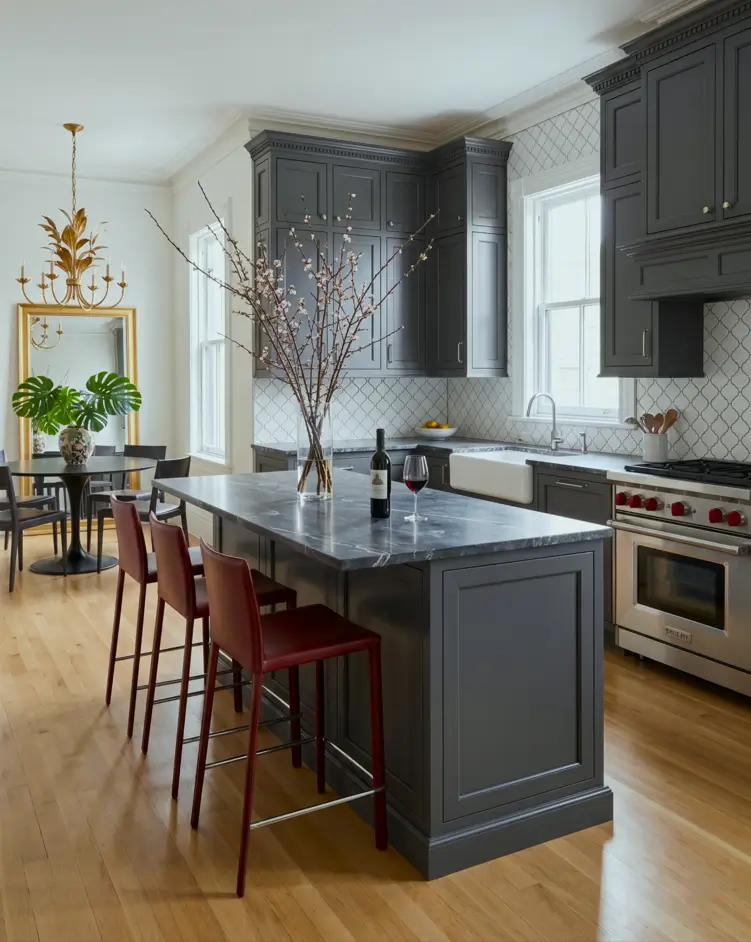
Charcoal-grey raised-panel cabinets give a Victorian kitchen a quieter, more tailored feel than black or navy. A dentil-molded cornice, a raised-panel hood, an arabesque-pattern tile backsplash, soapstone-look counters, and a farmhouse sink carry the period detailing. The grey reads soft in all that natural light.
11. Soft pink cabinets
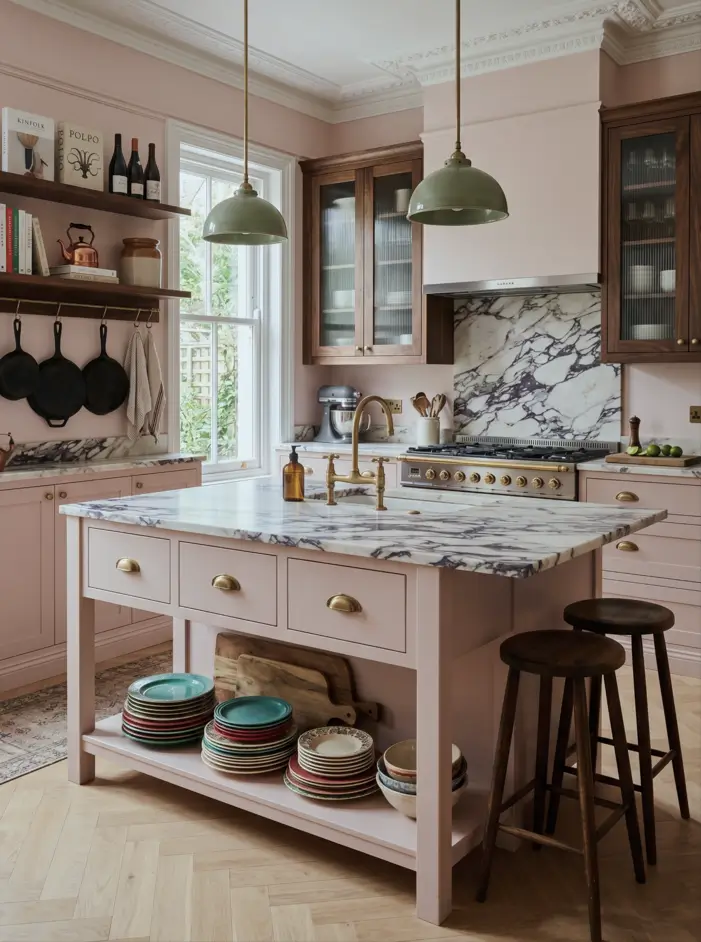
Don’t overlook pink in a Victorian kitchen — soft blush cabinets feel surprisingly at home against ornate crown molding and dramatic veined marble. Walnut glass-front cabinets, brass cup pulls, a brass bridge tap, and a freestanding island stacked with collected china warm it further. The marble keeps the pink from feeling sweet.
12. Deep red cabinets
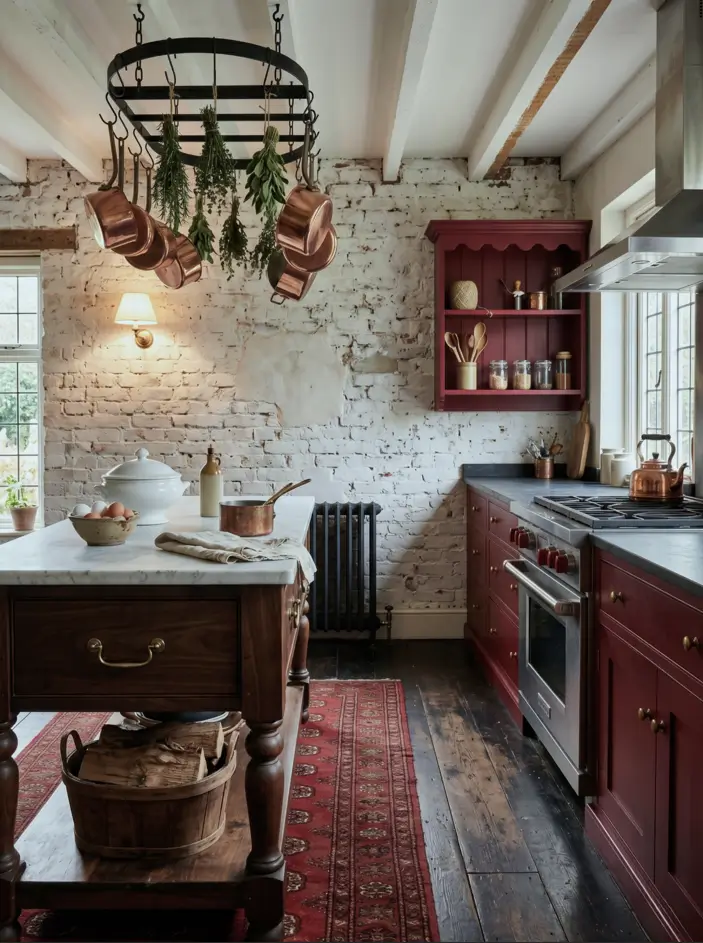
Deep oxblood-red cabinets bring real warmth to a Victorian kitchen, especially against limewashed brick. Here an iron pot rack holds copper pans and drying herbs above a marble-topped island, with a cast-iron column radiator nearby. The mix feels cozy and confident.
13. Natural wood cabinets
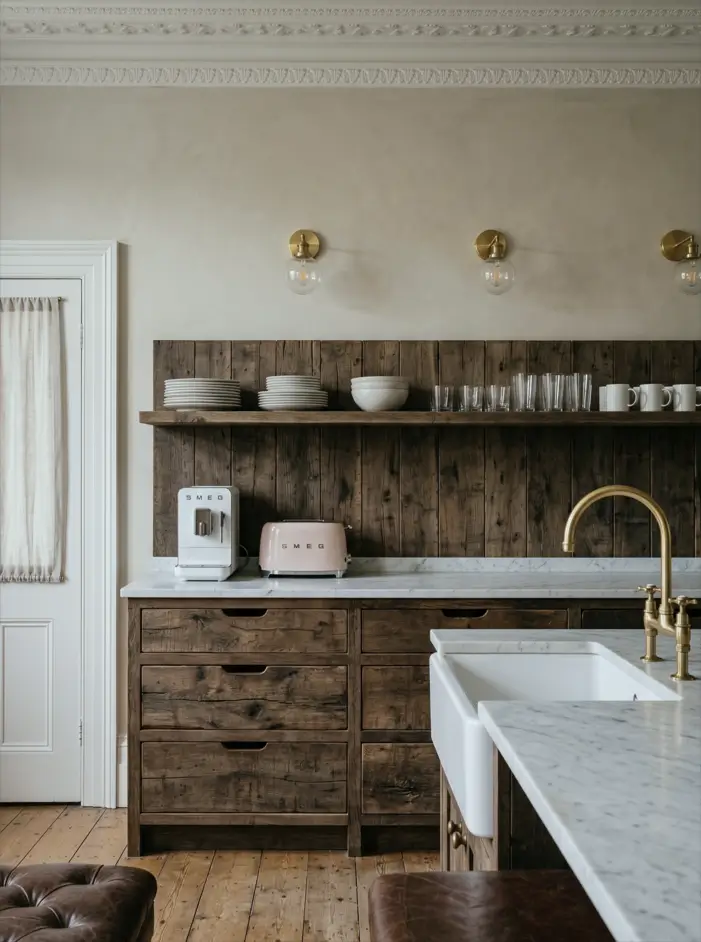
Rather than paint, this kitchen leaves its cabinetry in raw, reclaimed wood, which suits the quieter, architectural side of Victorian style. An ornate egg-and-dart plaster cornice, marble counters, a farmhouse sink, brass globe sconces, and an aged-brass tap do the period work above it. The grain brings all the warmth the room needs.
14. Dramatic black countertops
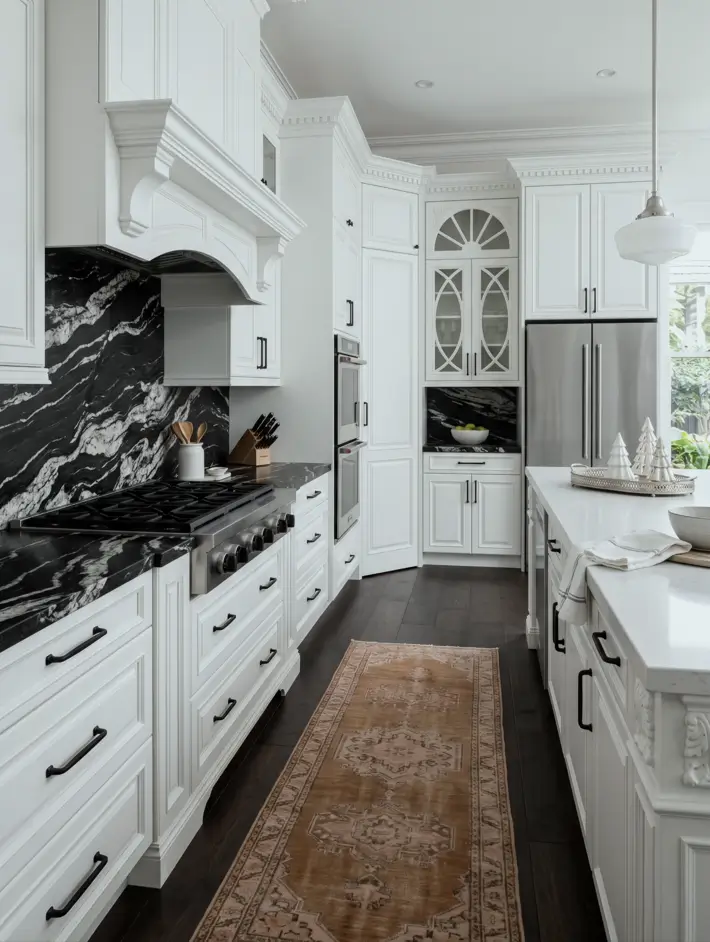
Countertops and backsplash in dark, veined granite give a white Victorian kitchen its drama, a classic high-contrast move for the style. Dentil crown molding, a carved-corbel hood, an arched glass-front cabinet, and raised-panel doors keep it formal. The black stone stops all that white from feeling plain.
Victorian Kitchen Islands: Furniture, Not Built-Ins
A Victorian kitchen island is most authentic when it reads as a freestanding piece of furniture rather than a built-in block. In the era, a large central table was where the household prepped and gathered, so the most convincing islands today are antique tables, carved oak pieces, or marble-topped bases on turned legs. You’ll often see a marble or butcher-block top and an open shelf below.
The freestanding approach has a practical upside I point out to clients all the time: an unfitted island keeps a big kitchen from feeling boxed in, and in an older house with uneven floors, a piece on legs sits far more gracefully than a fitted cabinet ever will.
15. Antique table island
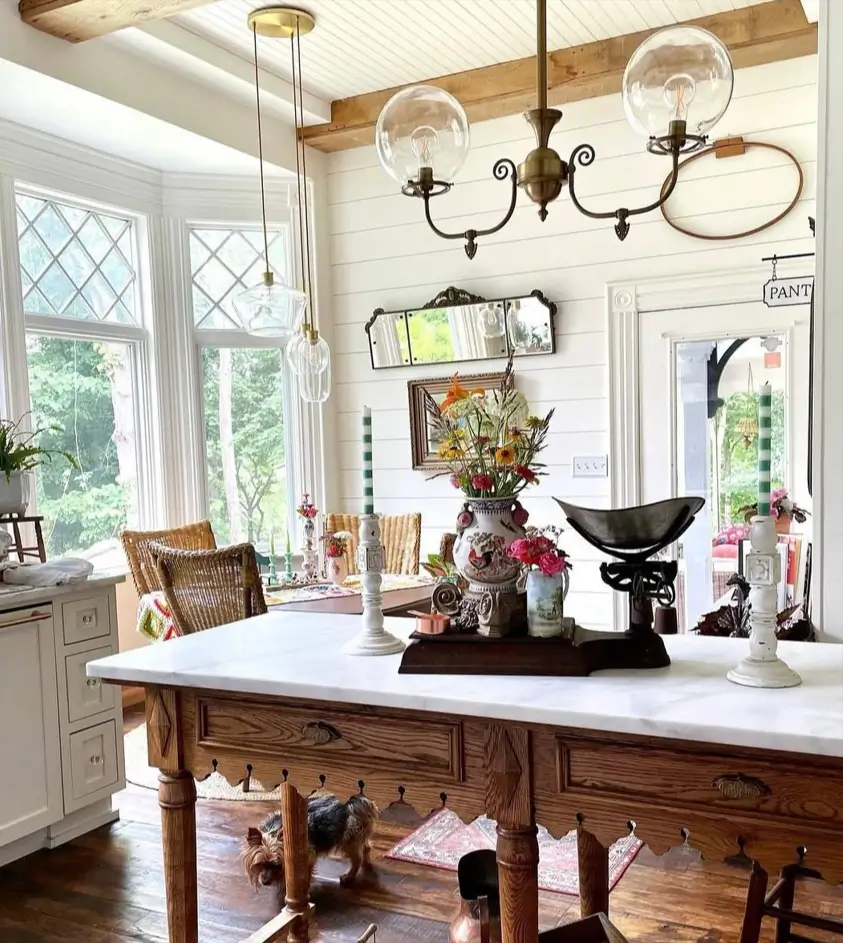
Rather than a built-in island, this kitchen uses a marble-topped antique table with carved apron details and turned legs — a very Victorian move. Leaded diamond windows, a brass scroll-arm light, and an old balance scale fill in the era. The mix feels collected, not staged.
16. Carved oak island
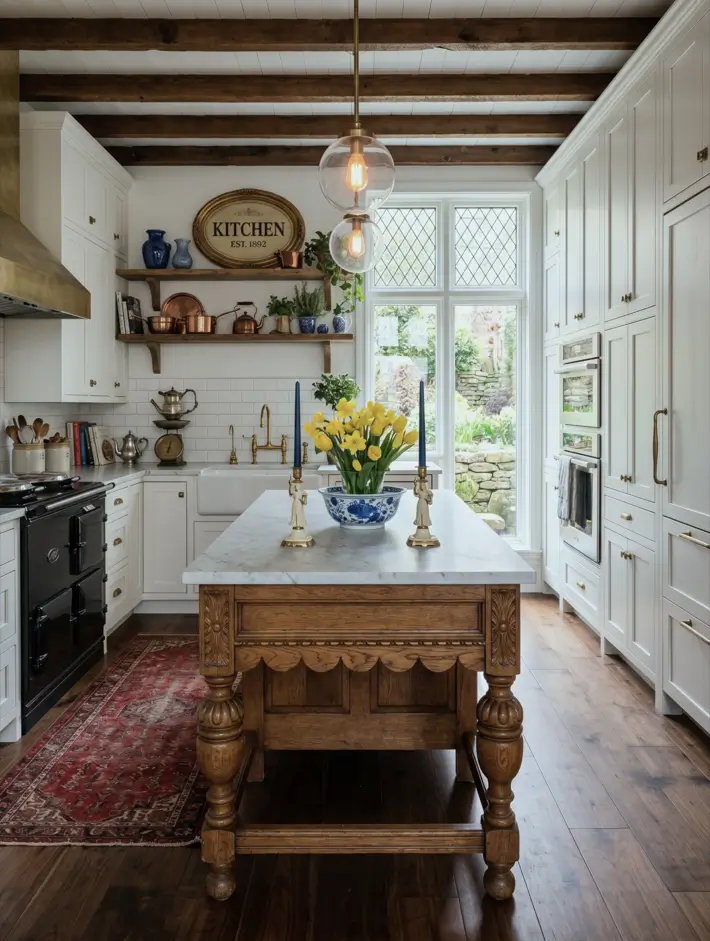
Many Victorian farmhouse kitchens lean on one real antique, and here it’s a carved oak island — turned legs, fluted corners, a scalloped apron under marble. A black AGA-style range, a farmhouse sink, a leaded diamond window, and copper on open shelves round it out. Mixing periods like this feels collected and warm.
17. Island with butcher’s hooks
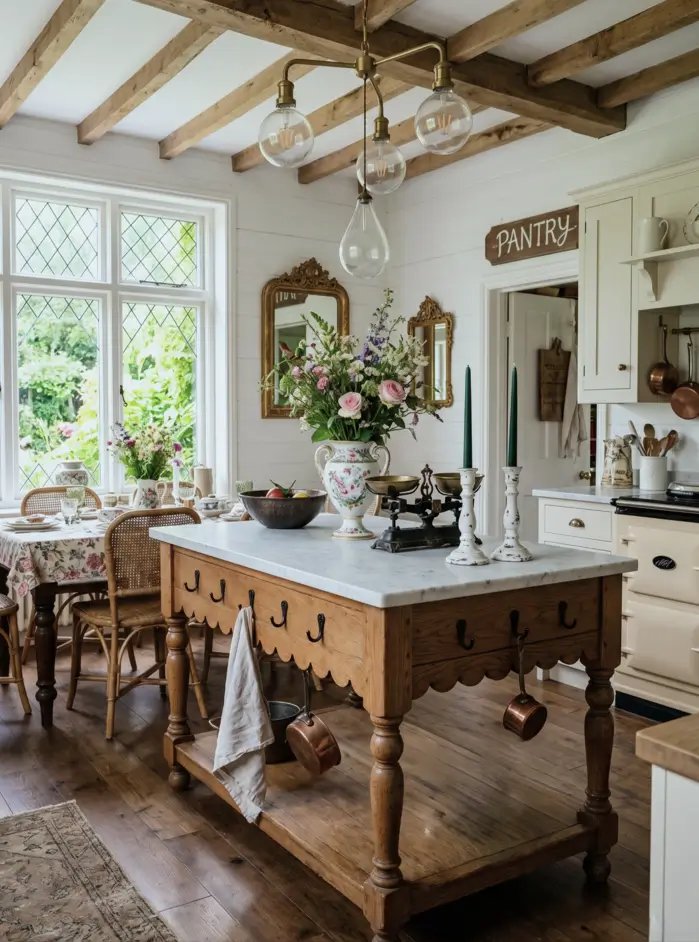
A carved oak island fitted with a row of iron butcher’s hooks along its apron holds copper pans right where you cook. Marble on top, turned legs below, with leaded windows, gilt antique mirrors, and a cream range filling out the room. It’s the kind of furniture-piece island that does real work.
18. Marble baker’s table
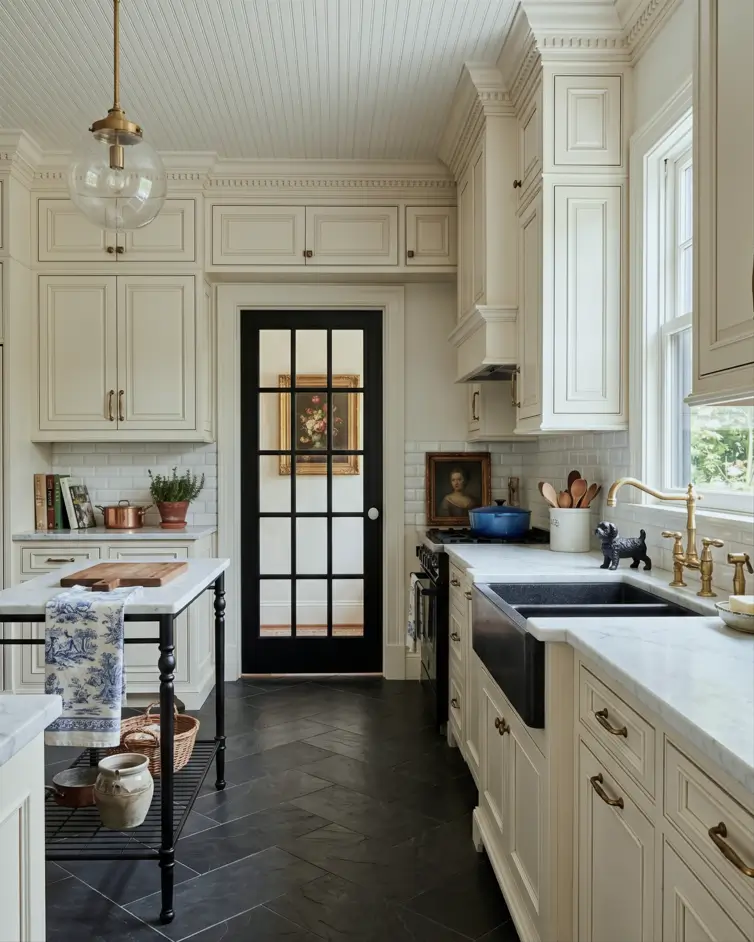
Standing in for a built-in island, this marble-topped metal baker’s table is a hardworking Victorian piece that keeps the room feeling unfitted. Cream raised-panel cabinets with dentil molding, gilt-framed oil paintings, a black slate herringbone floor, a farmhouse sink, and aged-brass taps fill it out. Classic and calm without ever feeling stiff.
19. Pink marble island
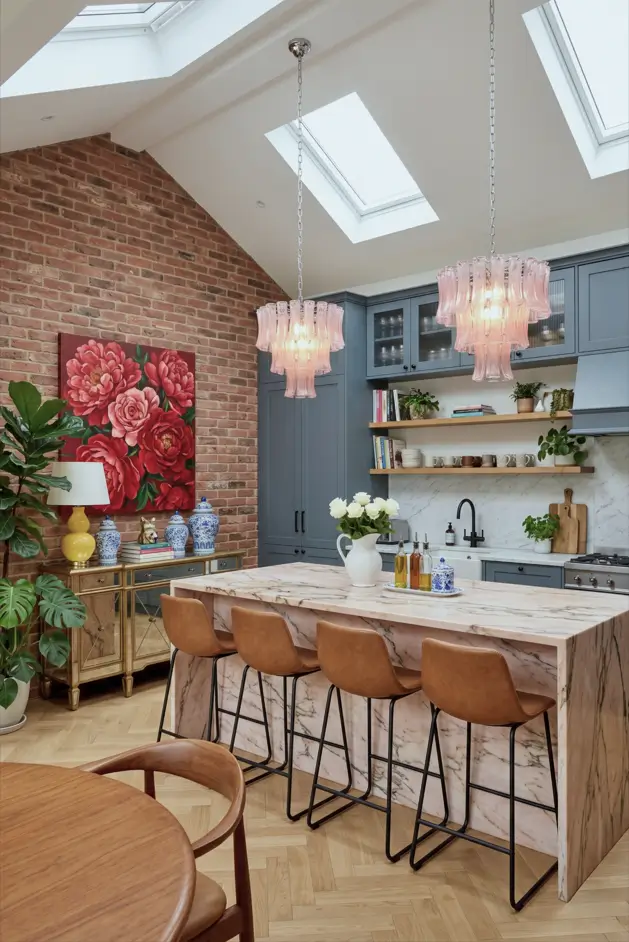
Pink-veined marble wraps this waterfall island, giving the kitchen a real centerpiece — the kind of statement stone Victorians would have loved. Around it, blue-grey cabinets, reeded-glass fronts, a mirrored sideboard, and blue-and-white ginger jars layer in old-world richness against exposed brick. Bold and glamorous, but the warm wood floor keeps it grounded.
Victorian Kitchen Tile & Flooring Ideas
Victorian kitchen flooring is best known for patterned encaustic tile, black-and-white checkerboard, and warm quarry or brick underfoot. These hardworking surfaces were chosen because they were easy to clean, but their geometry is what gives a Victorian kitchen so much of its character. On the walls, patterned encaustic and glazed tile bring the same period feeling up to eye level.
If you only borrow one idea from this section, make it the floor. I’ve seen a plain kitchen transform with nothing more than a checkerboard or encaustic tile laid corner to corner — it does more work than almost anything else in the room, and it ages beautifully.
20. Encaustic tile walls
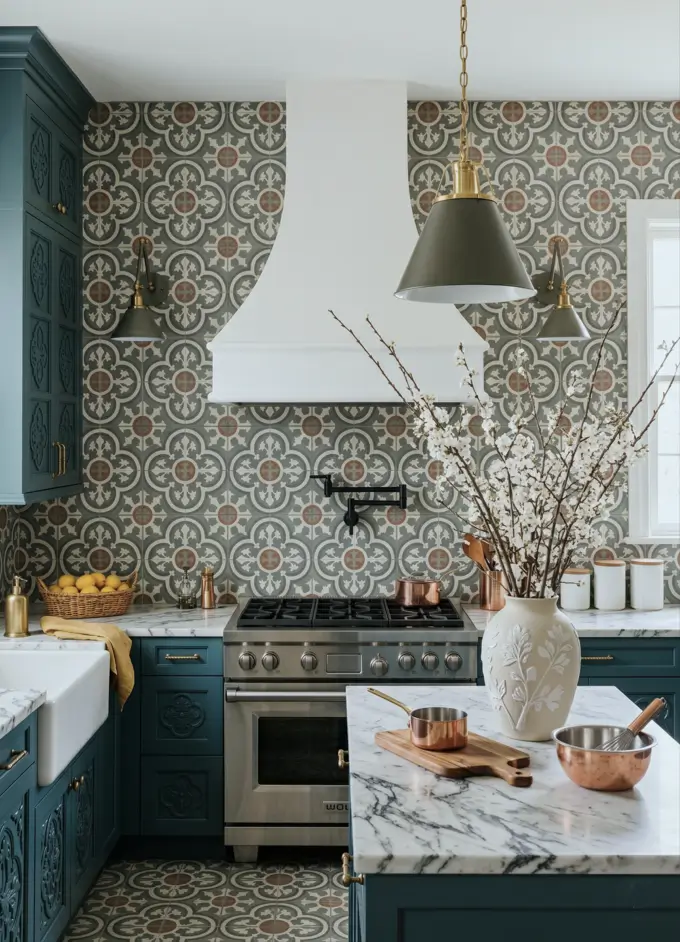
Carried from floor to backsplash, patterned encaustic tile gives this kitchen its unmistakably Victorian backbone. Teal cabinets with carved quatrefoil panels, a tall plastered hood, brass cup pulls, a marble island, and copper pans keep the era going. Running the tile right up the wall is bold, but it grounds the whole room.
21. Checkerboard tile backsplash
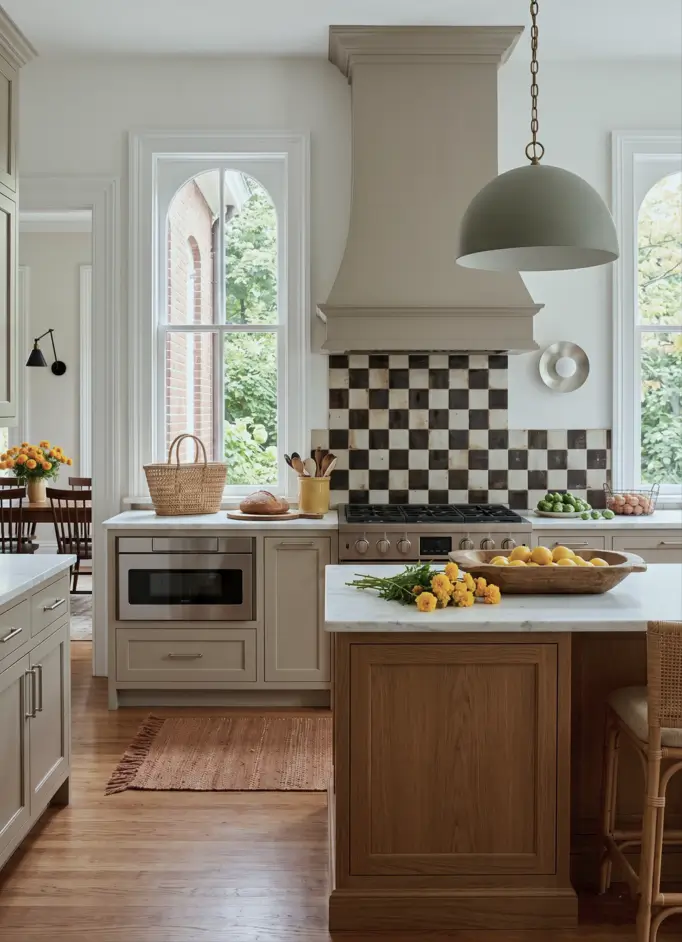
A black-and-white checkerboard backsplash gives this kitchen its Victorian pull, paired with a tall plastered hood and arched period windows. Marble counters, inset cabinetry, and a warm oak island soften the contrast, while the aged, hand-glazed tiles keep it from feeling too crisp. This look feels fresh but rooted.
22. Herringbone brick floor
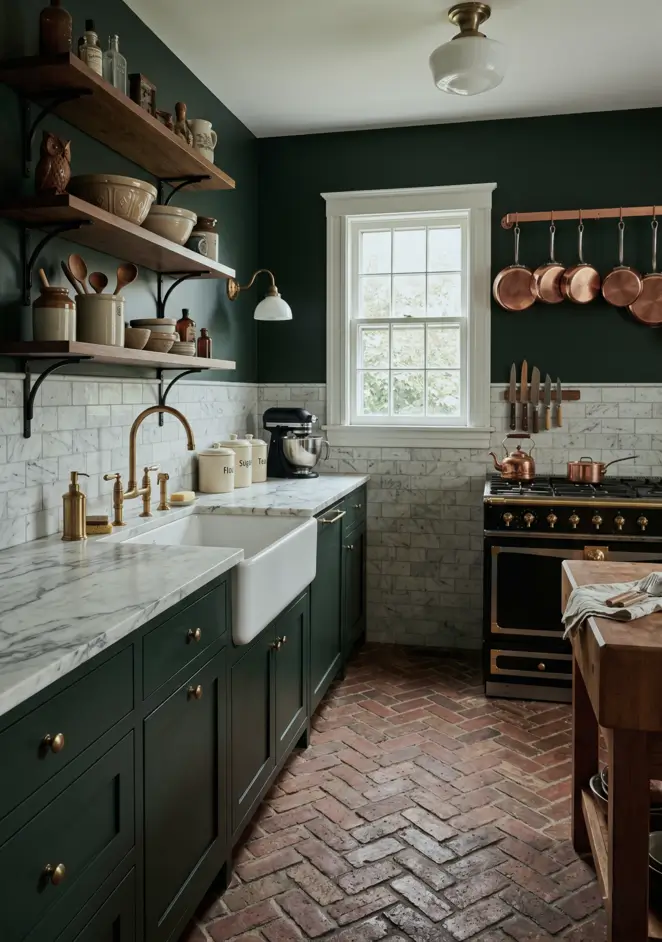
It’s common to find old brick underfoot in a Victorian kitchen, and here a herringbone brick floor warms a room of deep green cabinets. Marble subway wainscot, open shelves on iron brackets, a copper pot rail, and a black-and-brass range fill it out. The worn brick is what gives the space its age.
Modern Victorian Kitchen Ideas
A modern Victorian kitchen blends period detail with the openness and function we expect today. The idea is to keep the soul of the style — the moldings, glass-front cabinets, brass, and rich color — while letting in more light, simpler layouts, and contemporary appliances, much like the approach in modern Tudor interior design. You’ll often see a Victorian range hood and cabinetry paired with an open-plan layout or a streamlined island.
This is the version most of my clients actually want, and I understand why — few of us live the way a Victorian household did. If you’re styling beyond the kitchen, these modern Victorian home interior ideas carry the same approach through the house.
The trick is restraint: choose two or three strong period elements and let the rest stay calm. A modern Victorian kitchen that tries to do everything ends up looking like a stage set, which is the opposite of the easy, lived-in feeling we’re after — the same restraint that makes these modern Victorian living room ideas work.
23. Open-plan modern Victorian
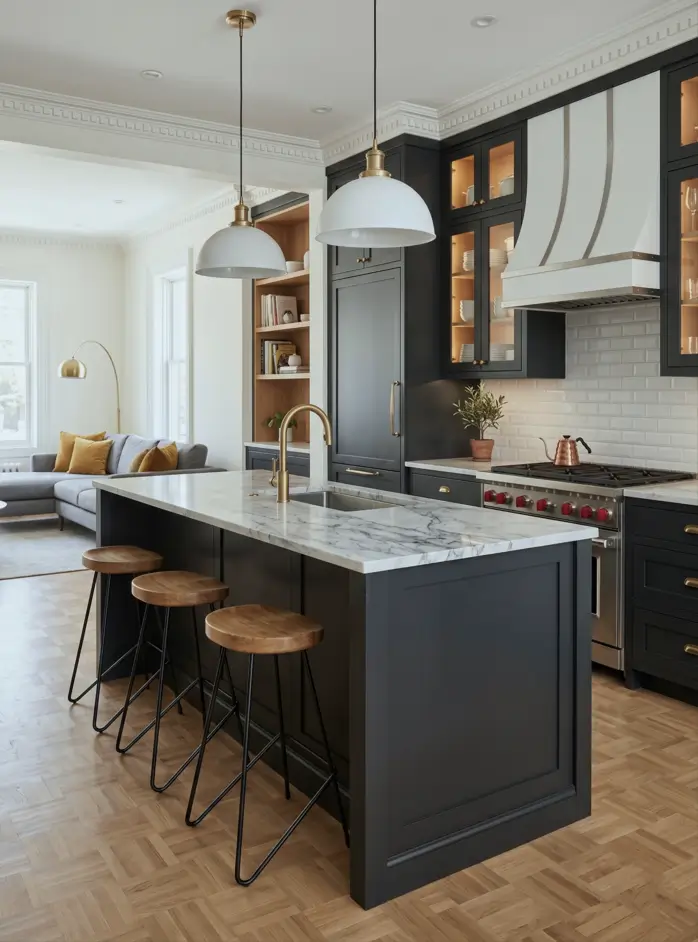
Instead of a closed-off room, this modern Victorian kitchen opens straight onto the living space, which is how a lot of people live now. Greek-key crown molding, glass-front cabinets, a curved banded hood, a marble island, and a brass tap keep the period feel, while herringbone floors tie it together.
24. Pale plaster hood
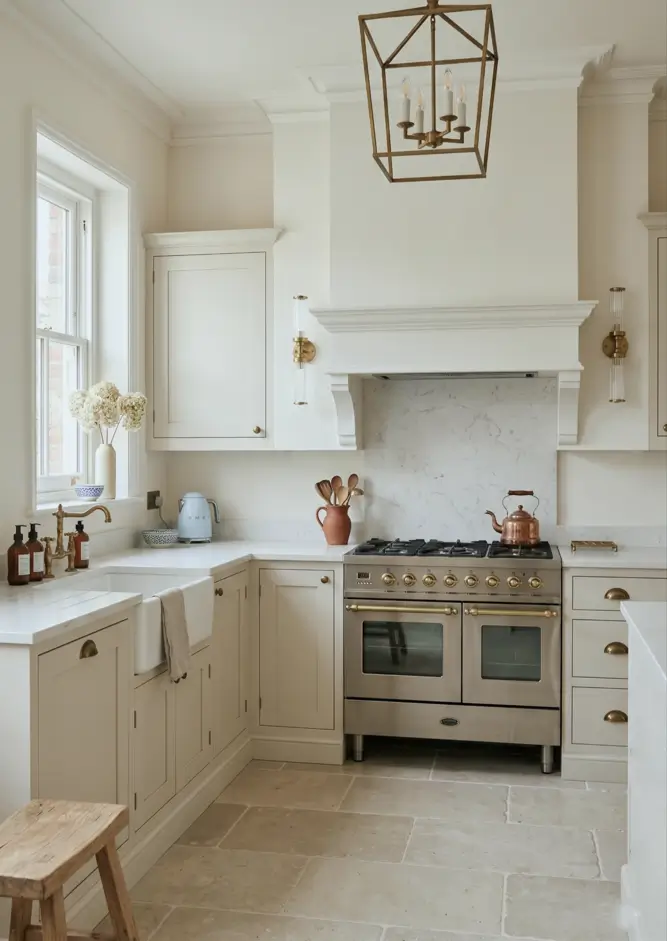
A tall plastered chimney-breast hood with a molded mantel shelf gives a soft, modern Victorian kitchen its quiet focal point. Warm cream shaker cabinets, brass cup pulls, an aged-brass bridge tap, a farmhouse sink, and a flagstone floor keep it gentle. Rather than dark and grand, this one feels light and calm.
25. Soft modern Victorian
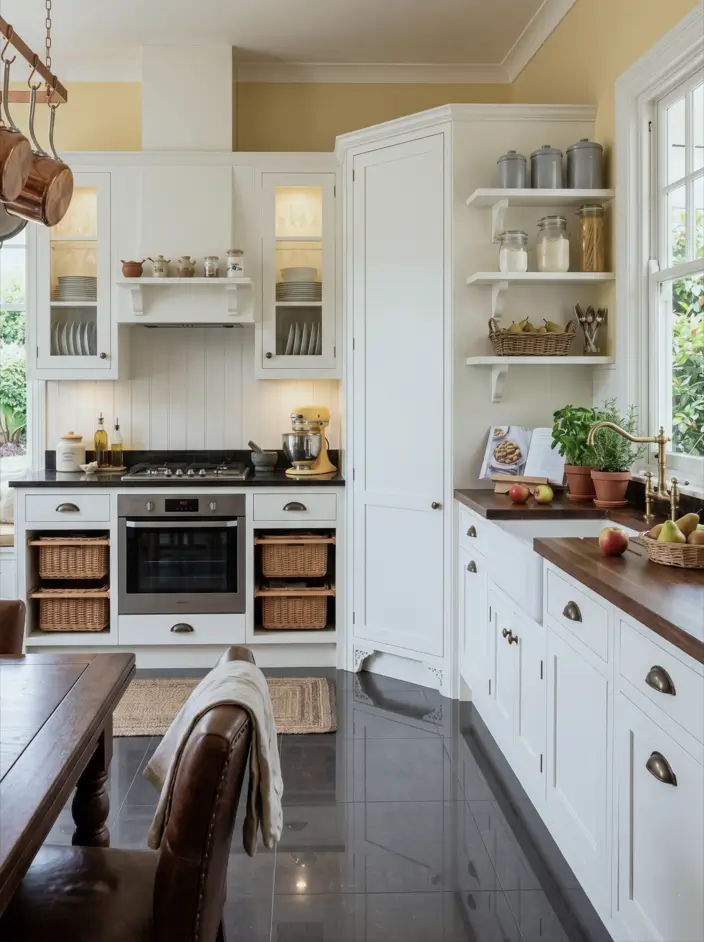
The modern Victorian kitchen leans light and airy here without losing its period bones. Glass-front cabinets, inset doors with carved corbel feet, a tall larder, brass cup pulls, and a bridge tap all read Victorian, while butter-yellow walls and butcher block warm it up.
26. Moody modern Victorian
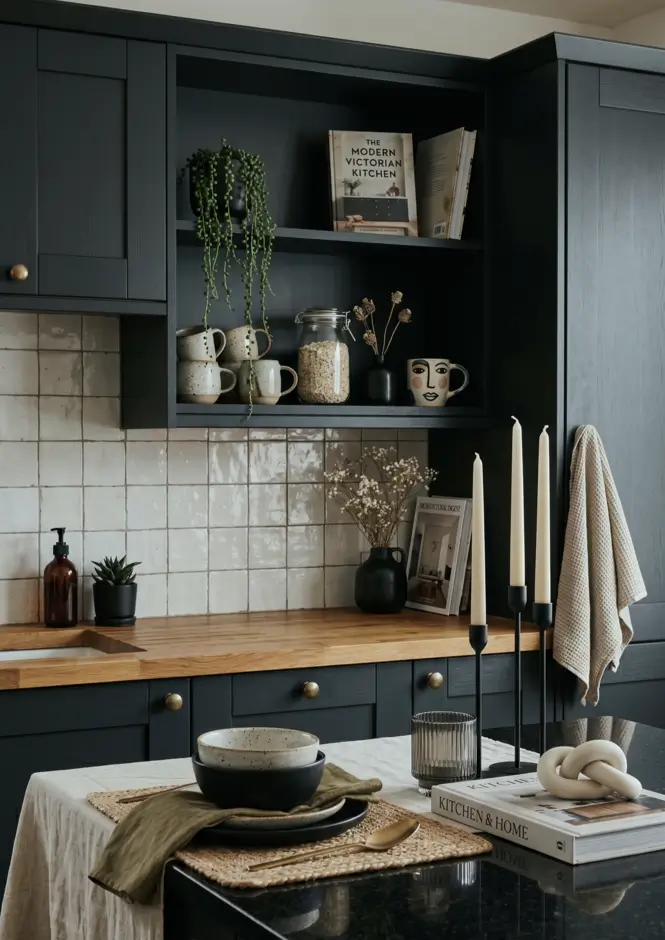
It’s common for a modern Victorian kitchen to lean dark and intimate, especially in a smaller space like this one. Charcoal shaker cabinets, brass mushroom knobs, a hand-glazed square-tile backsplash, and a warm butcher-block counter strike that balance. Styled with stoneware and trailing greenery, the corner feels snug rather than heavy.
27. Freestanding island table
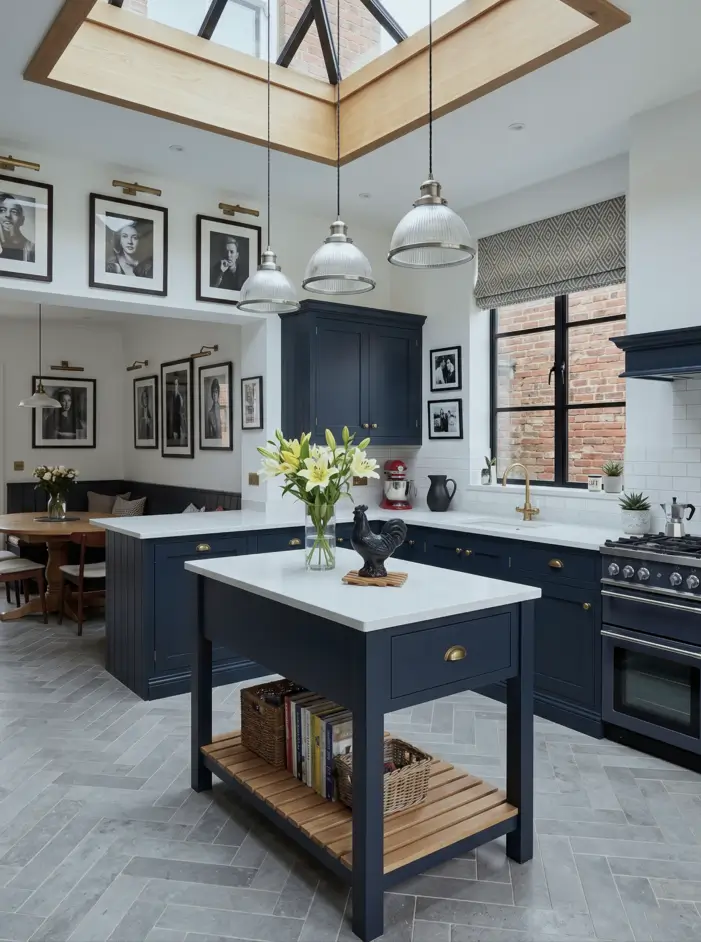
Instead of a built-in block, this kitchen uses a freestanding island built like a table, with an open slatted shelf below for books and baskets. Navy cabinets, brass cup pulls, a range cooker, exposed brick, and a roof lantern overhead give it a light, modern Victorian feel.
28. Bright extension galley
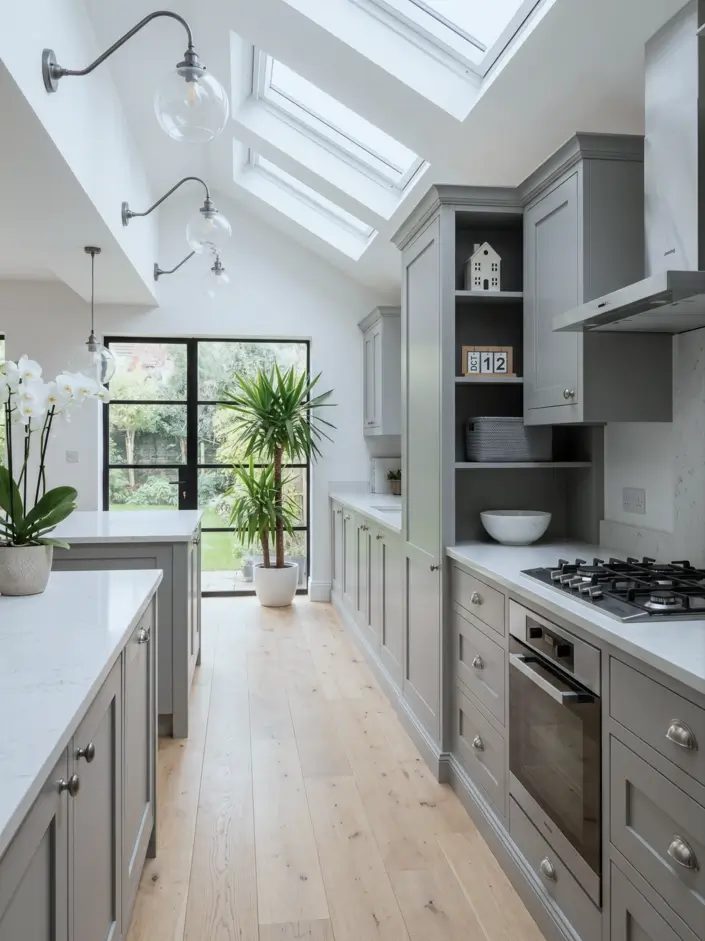
Works especially well in a Victorian side-return, this bright galley runs pale grey Shaker cabinets beneath a glazed, skylit roof. Cup-pull hardware, glass globe wall lights, marble-look counters, and a Crittall garden door give a nod to the period while keeping things light and modern. A good option when you want airy over ornate.
Small Victorian Kitchen Ideas for Period Homes
Small Victorian kitchens make up the reality of most period homes, where the original kitchen is often a narrow rear room or a compact cottage corner. The good news is that the style suits a small footprint beautifully. A freestanding range in a chimney recess, a butler’s sink under the window, and open shelving give you all the character without needing a grand room.
These are also the kitchens closest to how Victorians actually cooked, and I find them the most charming of all — they share a lot of DNA with English cottage house design. The wear on a quarry-tiled floor or an old cast-iron range isn’t a flaw to fix — it’s the patina that gives a small period kitchen its soul.
29. Original cast-iron range
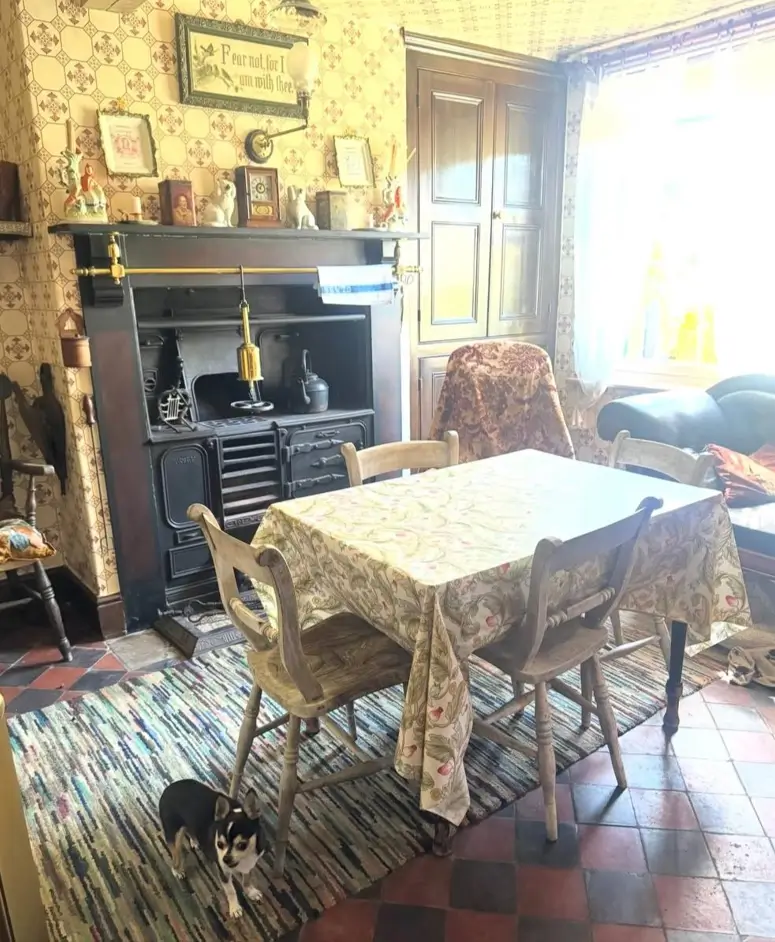
Here is the heart of a real Victorian kitchen: a cast-iron range built into the chimney breast, exactly where the household once gathered for warmth. Quarry-tiled floors, patterned wallpaper, a built-in cupboard, and a worn rag rug surround it. Nothing is polished or perfect.
30. Range in an alcove
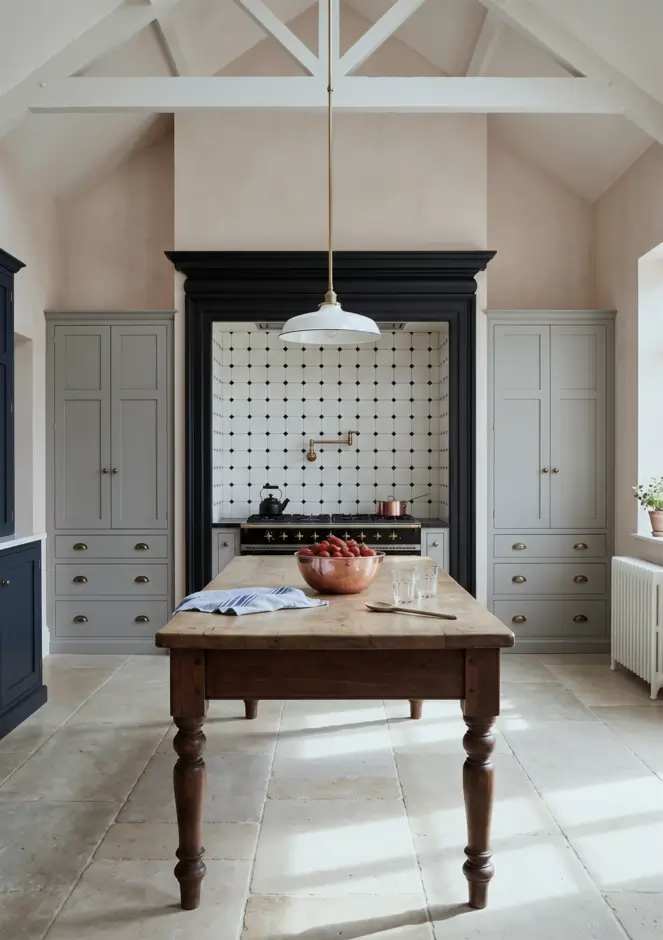
It’s common to find the range tucked into a chimney-breast recess in a Victorian kitchen, and here it’s framed in black against black-and-white octagon floor tile carried up the wall. A turned-leg pine table, brass cup pulls, a pot-filler tap, and a column radiator complete it.
31. Light-filled galley layout
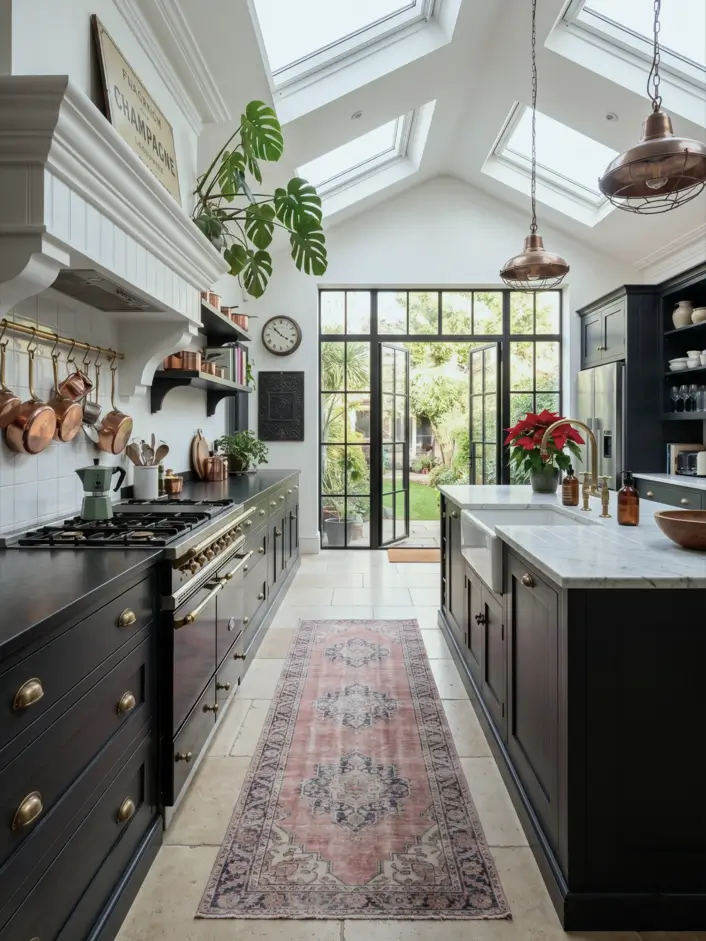
This galley Victorian kitchen runs two long runs of charcoal cabinets beneath a glazed, skylit roof, which works especially well in a side-return extension. A black-and-brass range, a copper pot rail, a marble island, a farmhouse sink, and a Crittall garden door anchor the period feel. All that overhead glass keeps a narrow plan from feeling tight.
32. Small cottage kitchen
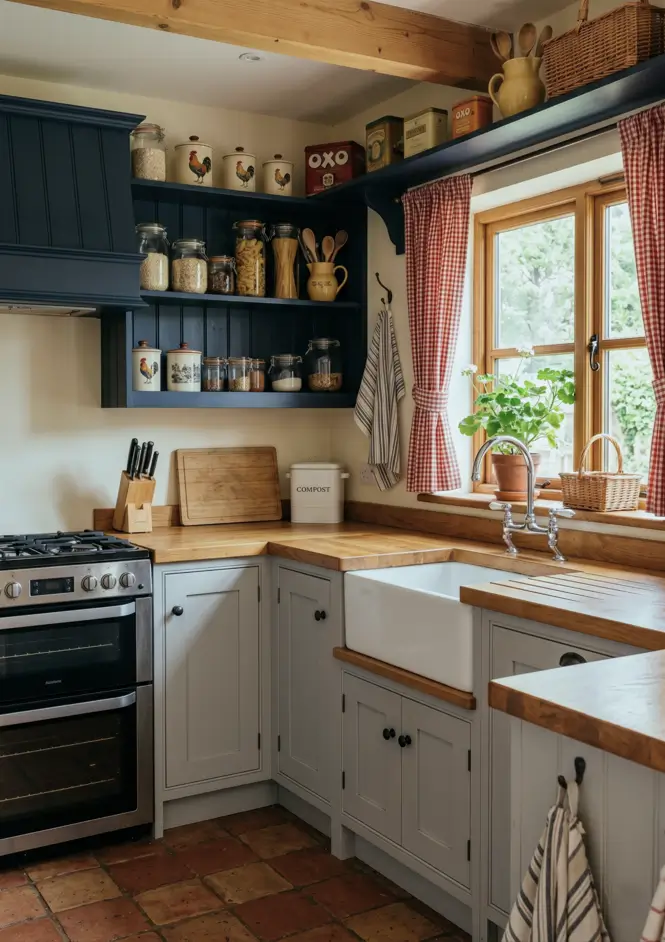
A small Victorian kitchen often looks much like this — a compact cottage corner with a terracotta quarry-tile floor, a butler’s sink under the window, and shaker cabinets worked into a tight footprint. Open shelves hold storage jars and old tins, and the gingham curtains keep it light.
33. Built-in plate rack
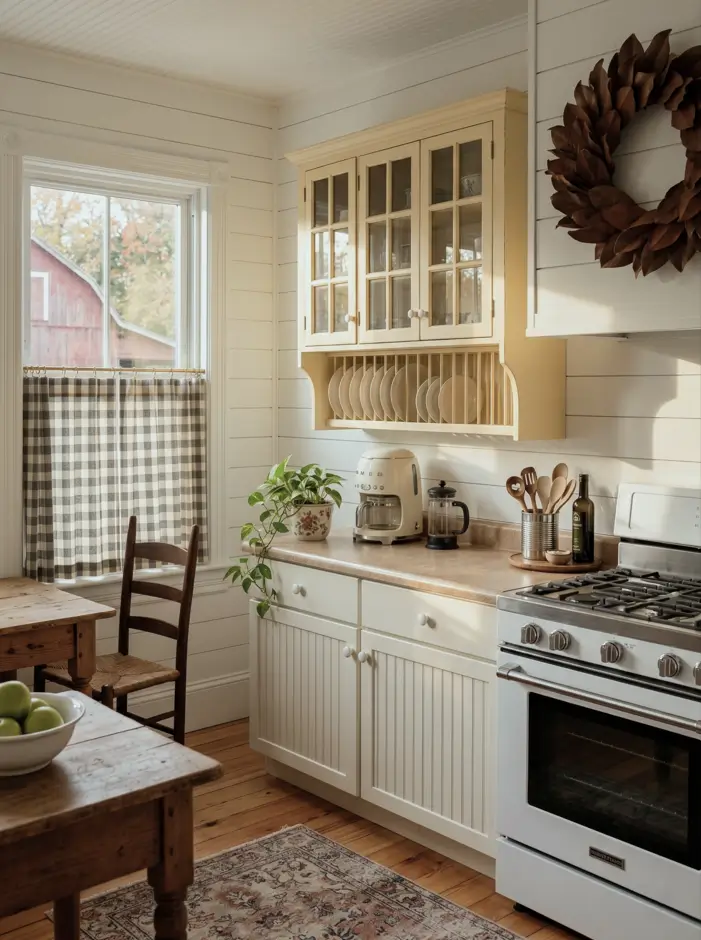
Built into the dresser cabinet, this plate rack is a genuine Victorian scullery feature, keeping everyday china drained and on show. Soft cream beadboard cabinets, a pine table, and gingham curtains give it a small, cottage-kitchen ease. The plate rack is the detail worth stealing here.
Victorian Kitchen Lighting, Hardware & Decorative Details
The finishing details — lighting, brass hardware, wallpaper, and framed art — are what make a Victorian kitchen feel complete. The era loved ornament, so this is where the room earns its personality. You’ll often see a brass or crystal chandelier, a pressed-tin ceiling, aged-brass cup pulls, patterned wallpaper, and copper or art hung as freely as in any other room.
These touches are also the easiest, most affordable way to bring the style into a kitchen you can’t fully renovate. Swap in brass hardware, hang a chandelier, add a roll of heritage wallpaper, and the room shifts. I often start clients here, because small changes show the look before they commit to cabinets.
34. Pressed-tin ceiling
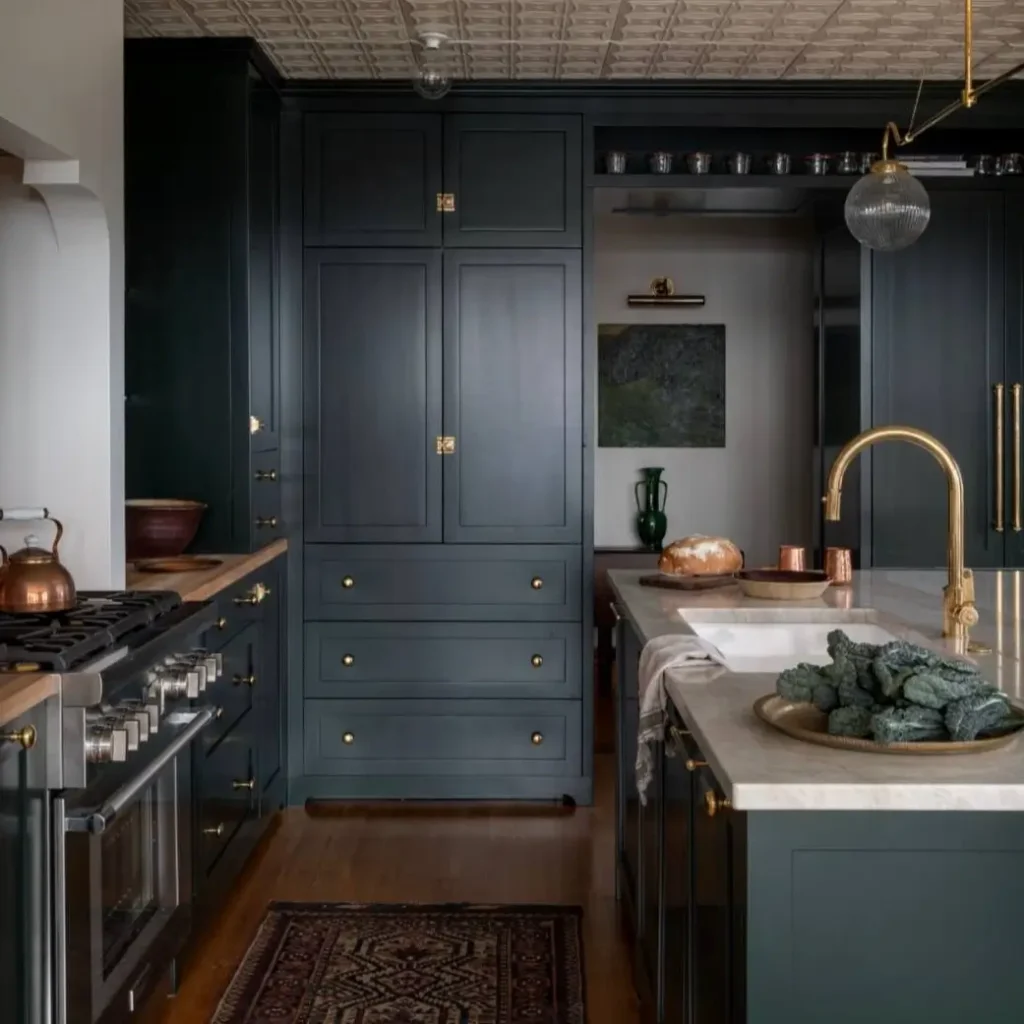
Few details say Victorian quite like a pressed-tin ceiling, and here it softens a room full of deep, moody color. The ironwork-style tiles sit above near-black inset cabinets, brass knobs, and a marble-topped island. Copper kettles and a worn runner keep it warm. We love how lived-in it feels.
35. Ornate brass chandelier
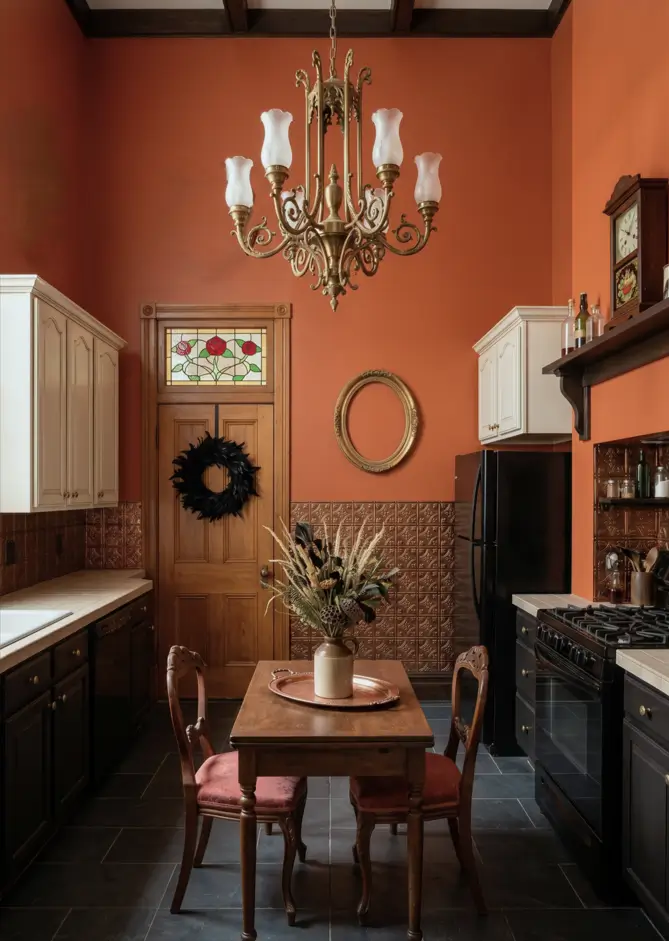
Lighting carries so much of the Victorian feeling, and here a brass chandelier with tulip glass shades sets the tone in a terracotta-walled kitchen. A stained-glass door panel, a pressed-copper backsplash, carved balloon-back chairs, and a gilt oval frame add to the layered, jewel-toned look. The high ceiling lets it all breathe.
36. Crystal basket chandelier
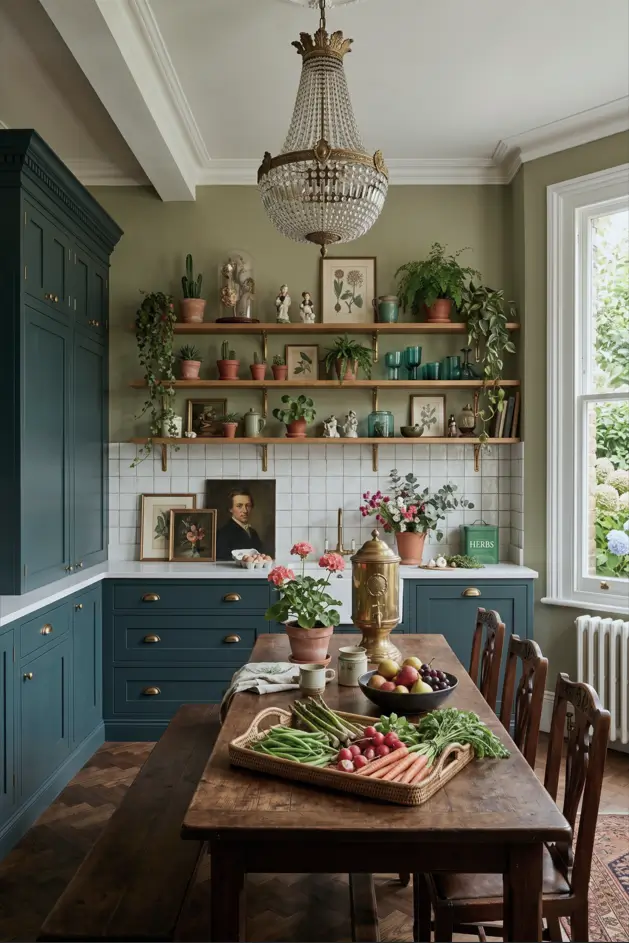
Overhead, a crystal basket chandelier brings a little formal sparkle to an otherwise easygoing Victorian kitchen. Blue-teal cabinets with a tall larder and dentil cornice, brass cup pulls, a farmhouse sink, and walls lined with botanical prints and an old portrait set the tone. The long table makes it a proper eat-in room.
37. Brass pot rail
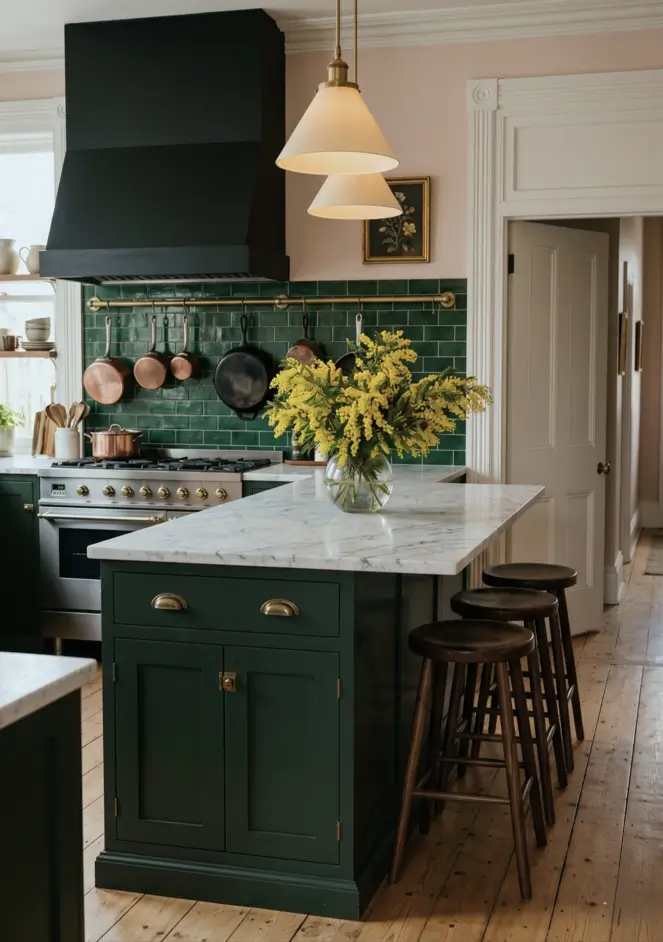
Hung over a glossy green subway-tile backsplash, a brass rail of copper pans is a hardworking Victorian touch that keeps everyday pieces within reach. Dark green inset cabinets, brass cup pulls, a marble island, and a brass-knobbed range fill it out, set against a soft pink wall. Useful and pretty at once.
38. Patterned wallpaper walls
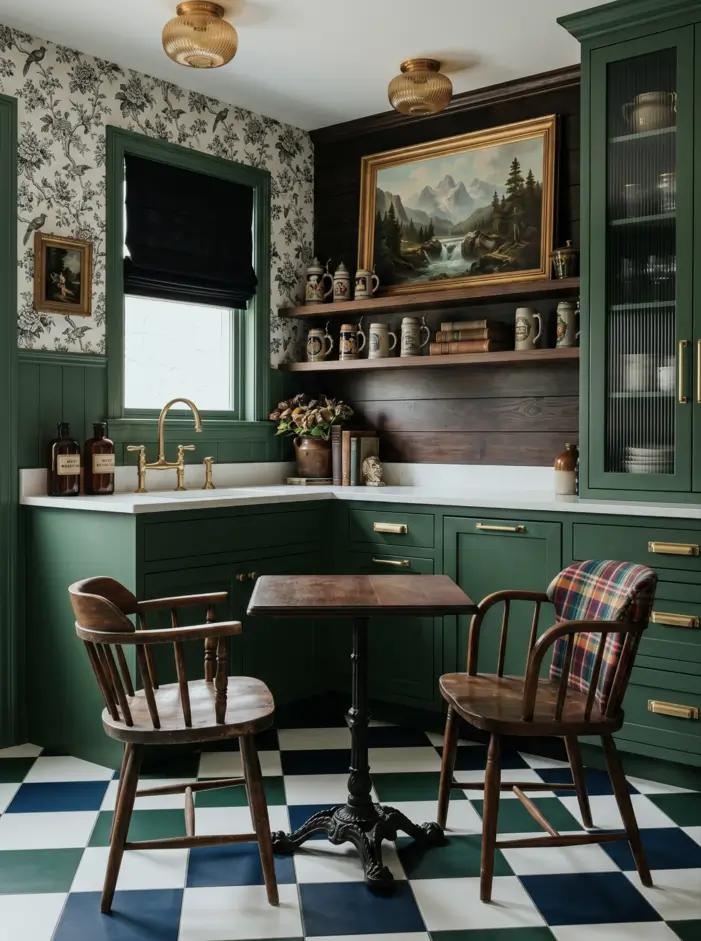
Patterned wallpaper is one of the quickest ways to read Victorian, and here a bird-and-floral toile sits above green beadboard wainscoting. A checkerboard floor, brass bridge tap, fluted-glass cabinet, framed landscape, and a collection of antique steins layer it further. Rather than feeling busy, the room feels like it has stories in it.
39. Floral heritage wallpaper
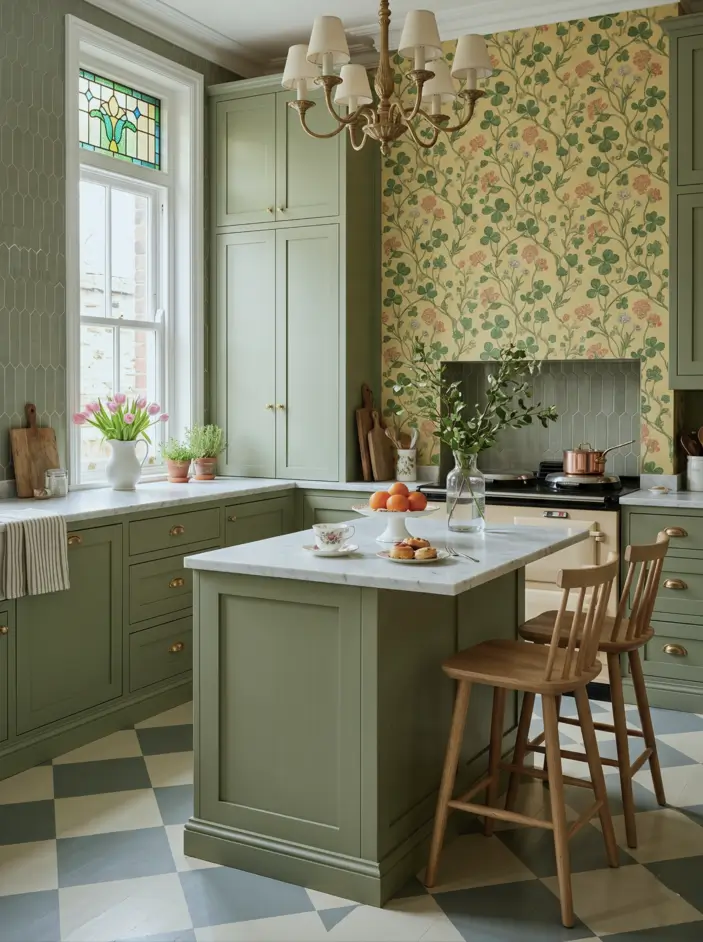
Floral heritage wallpaper, in the William Morris tradition, instantly reads Victorian, and here a trailing clover print climbs the chimney breast. Sage inset cabinets, a brass chandelier, a stained-glass window, and a marble-topped island laid for tea sit comfortably beneath it. The pattern does most of the work in the room.
40. Framed art above the counters
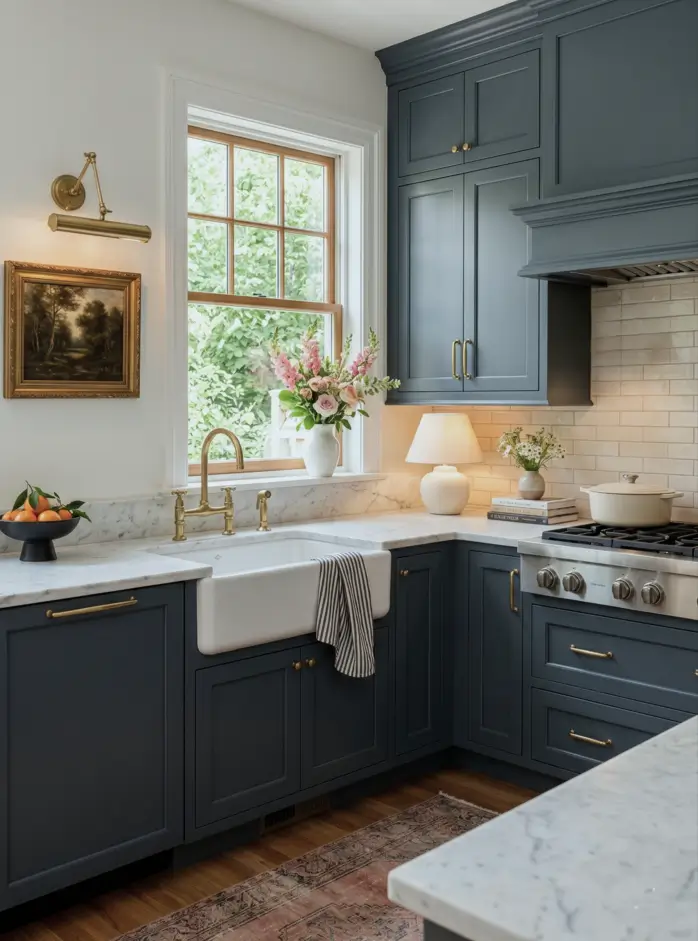
Hanging a gilt-framed oil painting right in the kitchen is a very Victorian habit, and here a landscape glows under a brass picture light beside slate-blue cabinets. Marble counters, a farmhouse sink, a brass bridge tap, and a subway-tile backsplash keep the period feel grounded. Treating a kitchen wall like any other room makes it feel collected.
Common Victorian Kitchen Mistakes to Avoid
The most common Victorian kitchen mistake is chasing a perfect, matched look, when the style depends on things feeling collected over time. I see it often: every finish coordinated, every surface new, every cabinet identical. The result is a room that reads as a showroom rather than a home. Victorian kitchens were layered and slightly mismatched, and that imperfection is exactly what gives them soul.
A few others worth knowing:
- Going all-white in the name of “modern Victorian” strips out the rich color the era was built on, and the room can end up looking like any other kitchen with a fancy hood bolted on.
- Choosing shiny, brand-new chrome hardware instead of aged brass breaks the spell faster than almost anything.
- Over-ornamenting every surface at once — patterned tile, patterned wallpaper, ornate molding, and a busy floor all competing — tips the room from characterful into chaotic.
My honest advice after years of doing this: pick two or three strong period elements and let the rest stay quiet. A deep cabinet color, a patterned floor, and good brass will carry the whole look. You don’t need every Victorian detail in one room — you need the right few, given space to breathe.
Frequently Asked Questions
What makes a kitchen look Victorian?
A kitchen looks Victorian through deep color, furniture-style cabinets, patterned tile, and ornate detailing like moldings, brass hardware, and glass-front cabinets. The era favored rooms that felt collected and layered rather than streamlined, so the best examples mix a freestanding piece or two with rich color, a farmhouse sink, and aged brass.
How do I make my kitchen look Victorian on a budget?
The most affordable way is through finishing details rather than cabinets. Swap modern hardware for aged-brass cup pulls, hang a brass or crystal chandelier, add heritage wallpaper to one wall, and display china on open shelves. Painting existing cabinets a deep green, navy, or oxblood shifts the whole mood instantly.
Are Victorian kitchens still in style in 2026?
Yes — particularly the modern Victorian look that pairs period detail with open, light-filled layouts. The appeal is warmth and character at a time when many people are tiring of cold, minimal kitchens. The style adapts easily: lean fully historic, or simply borrow color, brass, and patterned tile.
About the Author: Naraphon Kanyawee